Most Brands Are Missing One Of The Largest Growth Opportunities In America
For many U.S. brands, one of the largest untapped growth opportunities is sitting in plain sight.
Multicultural audiences.
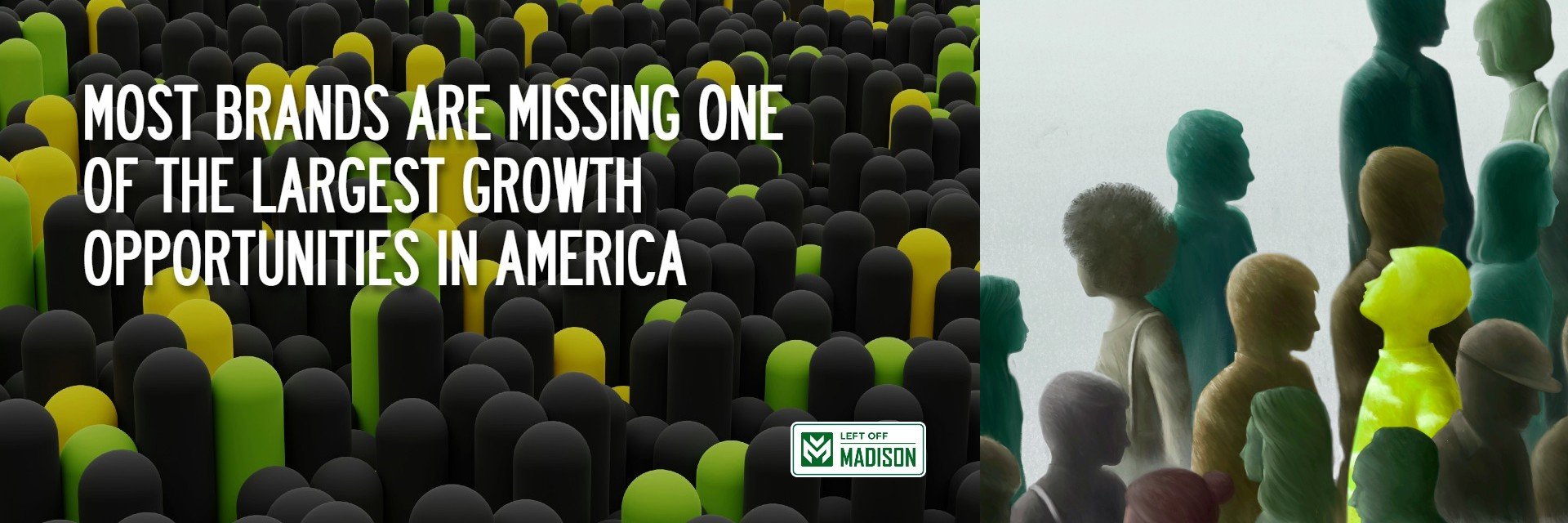
Not as a niche strategy.
Not as a specialty marketing discipline.
And certainly not as something reserved only for telecom companies, remittance brands, or imported food and beverage marketers.
But as one of the most meaningful— and most underdeveloped— sources of long-term business growth in America today.
The problem is that too many marketers still approach multicultural audiences through outdated assumptions.
Some assume their “general market” advertising already reaches these audiences effectively enough. (That’s because their ad agency leaders told them this and they are dead wrong.) Others reduce multicultural marketing to translation work, holiday campaigns, or isolated tactical efforts disconnected from broader brand strategy.
Both approaches leave enormous growth on the table.
Because multicultural audiences are not one audience.
They are dozens of distinct consumer groups with different:
media behaviors
cultural nuances
purchase drivers
language dependencies
family dynamics
trust systems
and emotional motivations
And increasingly, they represent the immediate and future economic engine of the United States.
The Growth Math Is Getting Harder To Ignore
According to recent Census and ACS data, the median U.S. household income sits around $80,734.
Now compare that to several Asian-American audiences:
Asian Indian households: ~$165,721 median income
Chinese households: ~$108,626
Korean households: ~$102,682
Filipino households: ~$90,000
That has major implications for categories like:
luxury and premium goods
financial services
investment platforms
travel and hospitality
healthcare
automotive
real estate
technology
high-end consumer electronics
These are not niche consumers.
These are often some of the highest-income, fastest-growing, and most globally connected audiences in the country.
And yet many brands still approach them with broad general market assumptions.
That is a mistake.

The “General Market” Myth
One of the most persistent myths in advertising is the idea that broad general market campaigns naturally and effectively reach multicultural audiences at scale.
Most agencies cannot actually prove this.
And the data often says otherwise.
Take Hispanic consumers in the United States.
MRI-Simmons audience data shows:
There are more than 47 million Hispanics age 18+ in the U.S.
Only ~15% use English exclusively at home
67% watched Spanish-language television programming in the last 30 days
Nearly half watch at least one hour of Spanish-language programming weekly
22% listened to Spanish-language radio in the past seven days
27% visited a Spanish-language website in the last 30 days
That is not “general market” media behavior.
We see similar patterns across Indian, Chinese, Korean, Middle Eastern, African-origin, and other multicultural audiences where in-language media consumption, cultural nuance, and trusted community ecosystems heavily influence attention and purchase behavior.
Which means many brands are unknowingly operating with a false sense of audience reach.
Multicultural Marketing Is Not Translation
This is where many agencies get it wrong.
Effective multicultural marketing is not simply about taking existing creative and translating it into another language.
It requires:
deep consumer understanding
cultural fluency
category expertise
behavioral insight
media precision
and emotional intelligence
The goal is not simply to “appear inclusive.”
The goal is to create relevance strong enough to influence behavior.
At Left Off Madison, we built 40+Madison specifically to solve for this.
A proprietary growth system designed to help brands identify and engage more than 40 multicultural audiences with precision across traditional and digital media ecosystems—with significantly less waste.
Because in our experience, multicultural marketing works best when it is approached as a serious growth discipline—not a side initiative.
What This Looks Like In Practice
Caesars Entertainment
Caesars Entertainment faced a major challenge: how to unify more than 40 property-level multicultural efforts into a centralized national growth strategy while competing against brands like MGM Resorts International and Wynn Resorts.
One of the biggest opportunities sat within Asian-American audiences— particularly Chinese and Vietnamese consumers who consistently over-indexed in gaming, dining, and entertainment spend.
Rather than targeting solely by country of origin, we segmented audiences by lifestyle and mindset, developing culturally nuanced campaigns in Chinese, Vietnamese, and Korean.
Importantly, the advertising intentionally avoided gaming-table imagery. Consumers already understood Caesars offered gaming. Instead, we focused on premium amenities, dining, entertainment, and broader lifestyle experiences.
The result:
Asian-American revenue growth doubled versus the general market
Asian guests drove 9% of total revenue despite representing only 4% of the audience
Centralized media generated 35% cost savings and 40% added value
The lesson: Multicultural growth is often unlocked not by louder messaging, but by more culturally precise positioning.

Western Union
Western Union was losing market share to digital-first competitors despite being one of the most recognized names in global money movement.
The insight was deeply human: For immigrant consumers, sending money is not just a transaction. It is emotional connection, family support, and cultural responsibility.
We built multicultural campaigns spanning Mexican, Filipino, Pakistani, Nigerian, Indian, and Chinese audiences allowing space for each culture’s unique emotional nuances while delivering hyper-targeted media and creative systems.
The outcome:
Three consecutive years of 5%+ year-over-year growth
Annual revenue increases of roughly 4%
+12% transaction growth during promotional periods
Significant increases in digital engagement
The takeaway: Even iconic legacy brands can reignite growth when they reconnect with the emotional truth behind why consumers choose them.
The U.S. Army 09L Program
The 09L recruitment initiative for the United States Army was not a typical marketing assignment.
It was a national security challenge.
The mission required recruiting Pashto, Dari, and Farsi-speaking U.S. citizens and green card holders to serve alongside American forces abroad.
This required reaching Afghan, Iranian, Pakistani, and Tajik-American communities with a level of trust and cultural fluency few institutions had ever attempted.
We built a culturally precise communications strategy spanning:
in-language media
diaspora platforms
trusted broadcasters
mosques
community hubs
ethnic radio
satellite television
culturally aligned seasonal timing
Rather than focusing on enlistment incentives, the campaign focused on identity, duty, pride, and purpose.
The result: The Army achieved recruitment goals seven years ahead of projections.
The lesson: Some audiences are not persuaded by advertising alone. They are moved by trust, purpose, and cultural respect.
The Real Opportunity
The future growth opportunity here is enormous.
Not because multicultural audiences are “emerging.”
But because many brands are still dramatically underinvested, under-segmented, and underdeveloped in how they engage them.
Why? More likely because, unlike us, other ad agencies don’t know what they’re doing or don’t want to put in the sweat-equity.
This is one of the last major white space opportunities remaining in many categories.
And the brands that approach it with:
precision
cultural fluency
audience intelligence
and integrated strategy
will create an advantage that becomes increasingly difficult to catch later.
At Left Off Madison, this is exactly how we think: strategy, media, creative, production, and cultural intelligence operating together as one integrated growth system.
Because multicultural marketing is not a specialty.
It is one of the most important growth strategies modern marketers still underestimate.