The Funnel Isn’t Broken. Demand Creation Is.
Why buying more media will not save brands that have failed to build awareness, consideration, and trust.
For years, marketers have been rewarded for visible activity.
More impressions. More clicks. More dashboards. More proof that something ran, something served, something moved through the machine.
But somewhere along the way, too many teams started confusing activity with impact.
That is the problem.
Impressions are not dead. They still matter. Reach still matters. Visibility still matters. But an impression, by itself, is not a growth strategy. It is just a moment. And if that moment is not connected to a larger system designed to build awareness, shape consideration, create trust, and drive action, it is just media exhaust.
That is where too many brands are stuck today: spending real money to show up, but not spending wisely enough to truly move people.
At Left Off Madison, we believe growth beats optics. Always. Marketing activity that looks busy but fails to build momentum is not performance. It is theater.
The lower-funnel trap
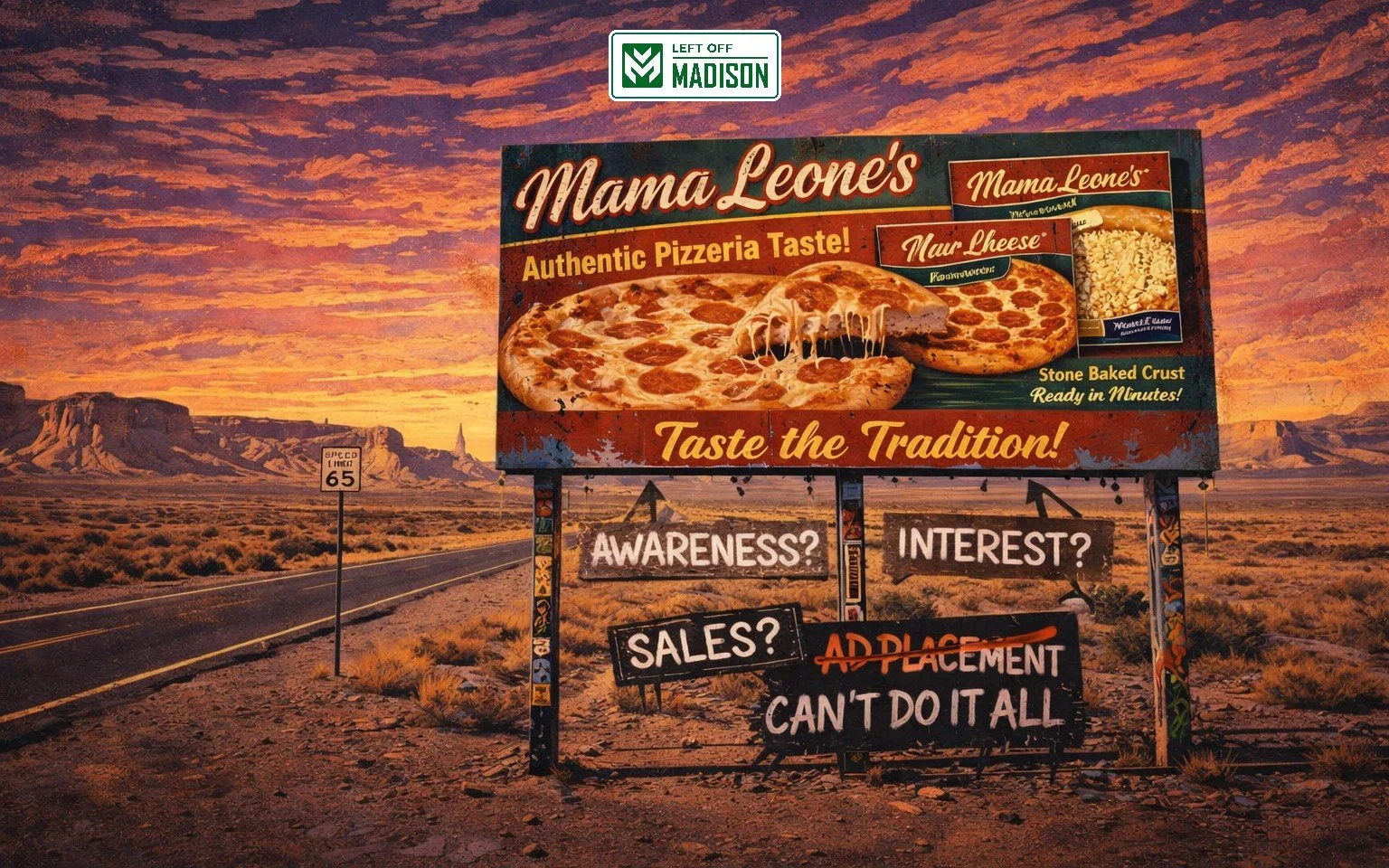
One of the most common mistakes in modern marketing is the belief that demand can be harvested without first being created.
You see it all the time with startups, challenger brands, and even long-established companies under pressure to produce immediate sales. They pour money into lower-funnel media because it feels measurable, immediate, and accountable. Paid search. Commerce media. Retargeting. Conversion campaigns. Retail media. Marketplace ads. Every dollar aimed at the last possible moment before purchase.
The logic sounds reasonable: get closer to the sale, and the sale should come faster.
But that logic breaks down quickly when the buyer has no real reason to care.
A conversion ad cannot do all the work by itself. It cannot introduce a brand from scratch, establish credibility, communicate differentiation, create emotional relevance, overcome doubt, and close the sale all at once. That is asking the last touch to do the job of the entire journey. This is the part amateur and novice marketers miss.
Performance media can capture demand already in motion. It cannot fully replace the work of creating that demand in the first place.
This is where too much modern marketing goes wrong. Brands become obsessed with the moment of transaction and neglect the conditions that make transaction possible.
Sales start before the store
Too many marketers still behave as though shopping is the beginning of the decision.
It is not.
By the time a consumer lands on a product page, types in a branded search, sees your Amazon listing, or walks down a retail aisle, a great deal of the decision has already been shaped. Not finalized, perhaps. But shaped.
What they buy is influenced by what they have already seen, heard, felt, and absorbed.
Do they recognize your brand?
Do they understand what makes it different?
Do they believe it is credible?
Do they know whether it is worth the money?
Do they trust it enough to choose it over something more familiar?
Do they have any reason to remember it at all?
These are not minor questions. They are the foundation of the sale.
That is why the obsession with end-stage efficiency often creates a strange kind of inefficiency. Brands spend heavily at the point of purchase trying to convert people who were never properly prepared to convert.
The problem is not that the media failed. The problem is that the brand arrived too late.
Impressions still matter. Isolated impressions do not.
This is where the conversation often gets sloppy.
When people say “impressions don’t matter anymore,” what they usually mean is that bad impressions do not matter. Empty impressions do not matter. Cheap impressions disconnected from business outcomes do not matter.
But meaningful impressions still matter greatly.
An impression can introduce.
An impression can reinforce.
An impression can build familiarity.
An impression can shape memory.
An impression can increase comfort.
An impression can make a brand feel more established, more credible, more relevant, more worth considering.
The issue is not the impression. The issue is whether that impression is part of something bigger.
Who saw it?
In what context?
With what message?
At what stage of readiness?
In support of what broader sequence?
What happened after?
One impression rarely closes the loop. But the right sequence of impressions, across the right environments, with the right messaging architecture, can absolutely change behavior.
That is what too many marketers miss. The value is not in any one impression. The value is in how impressions work together.
At Left Off Madison, we do not believe in disconnected tactics pretending to be strategy. We believe in building one integrated growth engine, where strategy, media, creative, and production work together to create momentum instead of isolated moments.
The full-funnel conversation is not old-fashioned. It is unfinished.
Somewhere along the way, “full funnel” started sounding boring to certain corners of the industry. Too traditional. Too broad. Too slow. Too top-heavy.
That is a mistake.
The full-funnel model is not outdated. If anything, it is more important now because the customer journey is more fragmented than ever.
People do not move in a straight line anymore. They discover brands in one place, hear about them in another, research them in another, and buy them somewhere else entirely. They may encounter your brand through social content, streaming video, search, retail shelves, a podcast mention, a creator, a review, a friend, an article, a display ad, or a marketplace listing. Often, several of those. Often, in no predictable order.
That is exactly why brands need a full-funnel system.
Not because every campaign needs equal money at every stage. It does not.
But because brands need deliberate coverage across the stages that matter:
Awareness, so people know you exist.
Consideration, so they understand why you matter.
Conversion, so interested buyers can act.
Reinforcement, so customers come back and the brand compounds.
When marketers overinvest in the bottom and starve the top and middle, they do not create efficiency. They create fragility.
Demand creation is still the real job
There is an uncomfortable truth buried beneath a lot of modern media planning:
Many brands are not underperforming because they lack conversion tactics. They are underperforming because they have not built enough demand, memory, preference, or trust to support the conversion tactics they are using.
This is especially common in categories where marketers assume the shelf, the platform, or the product page will do most of the heavy lifting.
It will not.
The shelf is not your strategy.
The product listing is not your positioning.
The last click is not your brand.
The buy-now button is not demand creation.
A lot of brands are effectively trying to rent demand instead of build it.
And when they do, the consequences show up fast: weaker conversion rates, higher acquisition costs, overreliance on promotions, vulnerability to competitors, and endless pressure to squeeze more from lower-funnel media that is already doing all it can.
That is not a growth engine. That is a treadmill.
The brands that win are not the ones that chase every measurable touchpoint with the most desperation. They are the ones disciplined enough to build belief before asking for action.
What smart marketers should do now
The answer is not to abandon performance media. It is to put performance media back in its proper place.
The strongest marketers today are not rejecting lower funnel. They are contextualizing it. They are treating it as one part of a broader growth system.
That means asking better questions:
Are we creating awareness in the right places, not just serving ads in the cheapest ones?
Are we building consideration with messaging that actually explains why we are worth choosing?
Are we sequencing creative in a way that matches consumer readiness?
Are we measuring only what is easiest to see, or are we measuring what actually matters?
Are we demanding short-term efficiency at the expense of long-term demand?
Are we optimizing channels in isolation, or are we orchestrating them to work together?
This is where marketing leadership starts to separate itself.
At Left Off Madison, this is exactly why we believe speed is a strategy, but only when direction is right. Moving faster toward the wrong outcome is not agility. It is waste.
The next generation of winners will not simply buy more impressions. They will demand more from every impression. More meaning. More alignment. More contribution to the larger growth story.
The new mandate
The impressions era is over in one important sense: impressions can no longer be the headline.
Outcomes are the headline.
Business movement is the headline.
Brand momentum is the headline.
That does not mean impressions lost their value. It means their value now depends on whether they are part of a disciplined system built to move perception, behavior, and results.
That is the real shift.
The marketers who adapt will stop asking, “How much media did we buy?”
They will start asking:
What did it build?
What did it change?
What did it move?
And how did each impression contribute to the outcome?
That is the standard now.
And frankly, it should have been all along.