Growth Watch List: 5 Brands In Decline, may 2026
What Household Penetration Data Quietly Reveals About The Brands Losing Momentum
Every year, brands spend billions trying to convince the market they are growing.
But consumer behavior usually tells a far more honest story.
At Left Off Madison, we spend a significant amount of time studying household penetration trends, buyer migration patterns, heavy-user behavior, and broader cultural movement because these signals often reveal marketplace vulnerability long before earnings reports, headlines, or stock analysts do.
And increasingly, one pattern keeps emerging:
Category growth no longer guarantees brand growth.
In fact, many legacy brands are losing users inside categories that are otherwise thriving.
Why?
Because consumers are changing faster than many brands are evolving.
Across industries — from spirits and restaurants to automotive, grocery, and even political identity — consumers increasingly reward brands, businesses, and institutions that feel:
culturally current
emotionally relevant
identity-enhancing
dependable
differentiated
or aligned with how people aspire to live today
Meanwhile, brands built around older assumptions, aging perceptions, operational inertia, or fading cultural codes are quietly losing household penetration — sometimes dramatically.
This month’s Growth Watch List explores five categories where the numbers reveal something deeper than simple market fluctuation.
They reveal shifts in identity, relevance, trust, aspiration, and consumer behavior happening in real time.
And in many cases, the decline started long before most leadership teams realized it.
1. Spirits: When Legacy Brands Stop Feeling Relevant
For decades, large spirits brands benefited from a fairly reliable formula:
Distribution. Awareness. Shelf presence. Repeat.
But new MRI-Simmons data comparing 2025 vs. 2022 suggests that formula is starting to crack — especially among legacy alcohol brands losing cultural relevance while newer brands gain momentum through lifestyle positioning, premium perception, and social visibility.
The most important signal isn’t simply declining sales.
It’s declining users.
And more specifically: declining heavy users.
Because when heavy users begin leaving first, broader household penetration erosion often follows.
The category split itself is telling.
Rum users declined by 2.6 million consumers (-8%), while heavy rum users fell by 803,000 (-13%). Meanwhile, tequila users grew by 1.3 million (+3%), with heavy tequila users increasing by 554,000 (+8%).
This isn’t just about taste preference.
It reflects a broader cultural shift in how consumers increasingly associate certain spirits with status, identity, nightlife, premium experiences, and modern social behavior.
Tequila has become culturally ascendant.
Rum, particularly legacy rum, increasingly feels tied to older drinking occasions and aging brand codes.
That distinction matters.
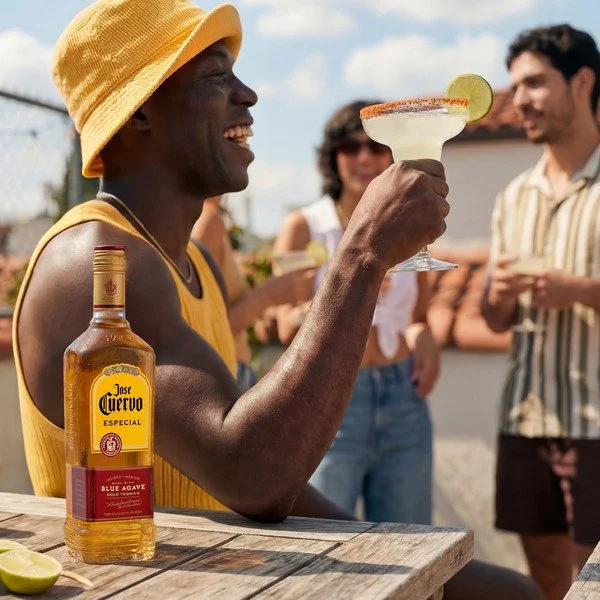

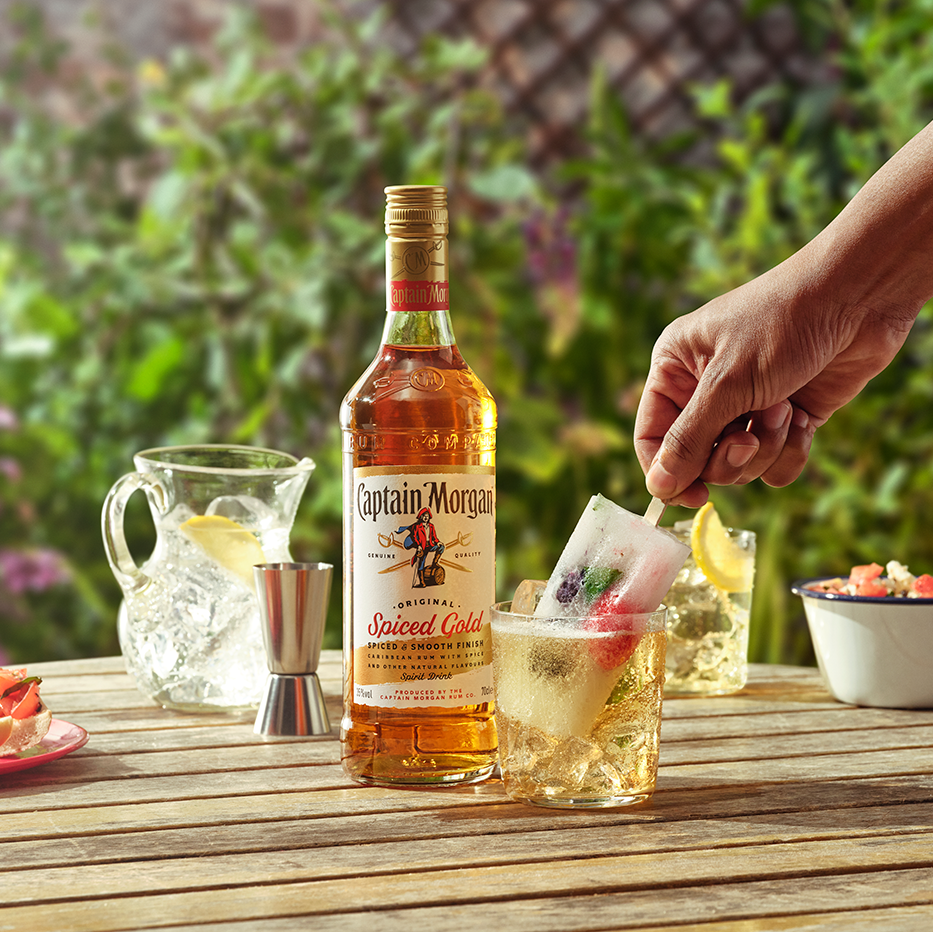
Take Bacardi, which lost 951,000 users (-13%). The challenge likely isn’t awareness. Bacardi remains one of the most recognizable names in spirits. The issue may be that awareness alone no longer guarantees relevance. Younger consumers increasingly gravitate toward brands that feel curated, premium, and socially expressive. Bacardi still feels functional to many consumers, while newer brands feel symbolic.
Similarly, Captain Morgan lost 696,000 users (-10%). The brand historically thrived around party culture, humor, and mainstream nightlife. But drinking culture has evolved. Modern premiumization increasingly rewards craftsmanship, aesthetics, authenticity, and elevated cocktail experiences. In many ways, the category moved upscale while Captain Morgan remained associated with older definitions of fun.
Yet rum itself is not dead.
That’s what makes the rise of smaller players so interesting.
Calico Jack grew by 274,000 users (+107%), while Admiral Nelson's gained 212,000 users (+41%). Those gains suggest consumers are still highly willing to experiment within the category — particularly when brands feel approachable, discoverable, or socially relevant.
Meanwhile, tequila’s growth story increasingly looks less like a spirits trend and more like a lifestyle movement.
Legacy giant Jose Cuervo fell by 1.55 million users (-14%), while Sauza declined 24%. Both brands maintain strong awareness, but much of tequila’s modern growth has shifted toward premiumization, elevated social rituals, luxury hospitality, celebrity influence, and aspirational identity signaling.
That shift disproportionately benefited brands like Casamigos, which gained 2.7 million users (+73%), and Don Julio, which added 1.67 million users (+24%).
Neither brand simply sold tequila.
They sold lifestyle.
Consumers didn’t just drink Casamigos or Don Julio. They were seen drinking them. In today’s spirits market, that distinction increasingly drives penetration growth.
The broader lesson for marketers is difficult but important:
Category growth no longer guarantees brand growth.
In fact, many legacy brands are now losing users inside categories that are still expanding.
Because increasingly, consumers aren’t simply buying products.
They’re buying identity, cultural relevance, and brands that help communicate who they are — or who they aspire to become.
2. Motorcycles: When Performance Alone Stops Winning
The motorcycle category is shrinking.
MRI-Simmons data shows recent buyers of new motorcycles declined by 342,000 consumers overall. But beneath that broader slowdown is a more revealing story: some brands are still growing aggressively while legacy players lose momentum.
Suzuki lost 332,000 recent buyers (-28%), while Honda declined by 342,000 buyers (-11%).
Meanwhile, Kawasaki gained 390,000 recent buyers (+37%), and BMW added 69,000 buyers (+13%).
That divergence suggests this is no longer simply about motorcycles themselves.
It’s increasingly about identity.

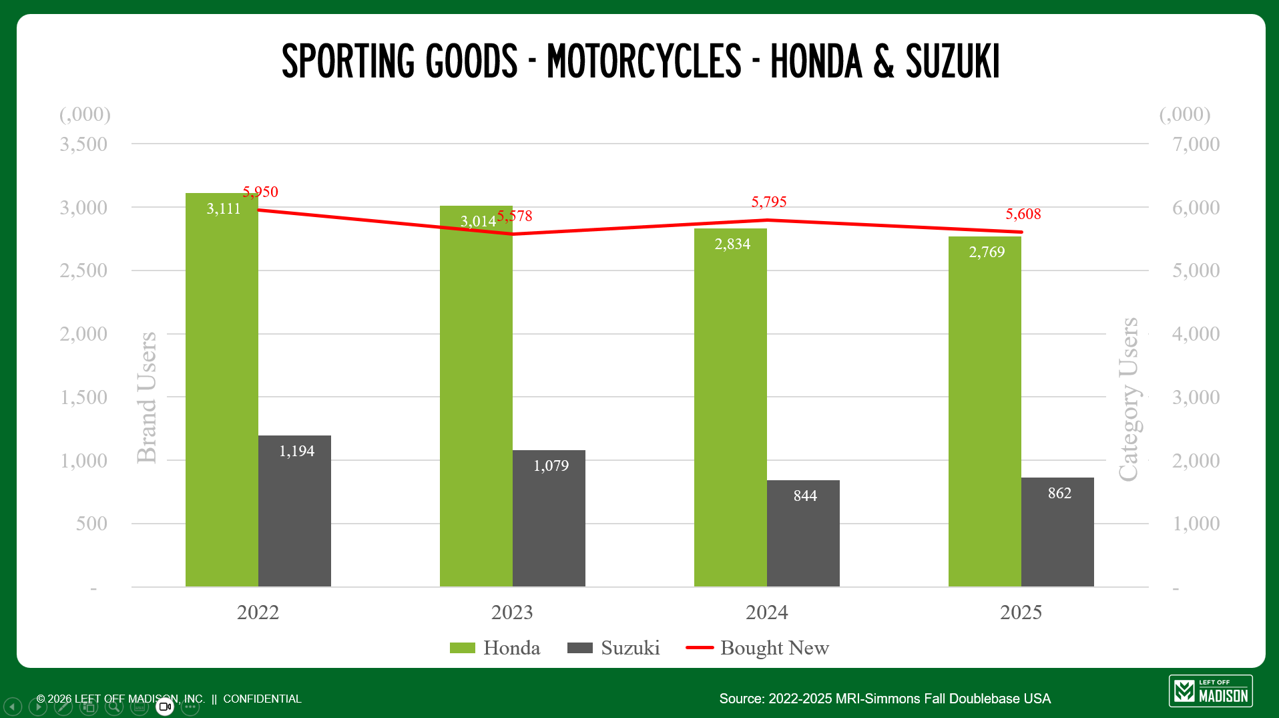

Historically, brands like Honda and Suzuki benefited from broad accessibility, engineering credibility, dealer networks, and practical reliability. But modern motorcycle culture has shifted from purely functional transportation toward lifestyle signaling, adventure culture, premium experiences, and enthusiast communities.
In many ways, motorcycles have become more emotionally purchased than rationally purchased.
That shift appears to favor brands with stronger aspirational positioning.
Kawasaki continues benefiting from performance-oriented brand equity tied to sport culture, younger riders, and aggressive styling. BMW, meanwhile, has increasingly positioned itself less as a motorcycle manufacturer and more as a premium adventure and touring lifestyle brand — attracting affluent consumers seeking experience, exploration, and status alongside performance.
The warning sign for legacy brands is clear: Product quality alone is no longer enough to sustain household penetration.
Consumers increasingly want brands that project identity outwardly — not simply brands that “work.”
And in categories driven by passion purchases, culture often moves faster than legacy perception.
3. Automotive: The Middle Is Collapsing
The automotive market isn’t simply shifting toward EVs.
It’s polarizing.
Consumers increasingly gravitate toward either:
brands associated with innovation and future-forward identity
or brands that deliver trusted long-term value and consistency
The brands struggling most are often trapped somewhere in between.
MRI-Simmons data comparing 2025 vs. 2022 reveals significant buyer erosion across several legacy automotive brands.
Dodge lost 1.64 million recent buyers (-25%), while Chrysler fell by 603,000 buyers (-19%). Cadillac declined 14%, and Jaguar suffered the steepest drop of all — down 54%.
Meanwhile, the winners reveal where momentum is flowing.
Tesla gained 1.39 million recent buyers (+120%), while Porsche grew 55%. At the broader market level, Hyundai added 1.55 million buyers (+17%) and Toyota gained 2.31 million buyers (+7%).
What’s happening here is less about drivetrains and more about clarity of brand meaning.
Tesla continues benefiting from its position as both an automotive company and a cultural symbol tied to technology, innovation, and future identity. Consumers aren’t simply buying transportation. They’re buying participation in what feels like the next era of mobility.
Porsche, meanwhile, continues owning emotional aspiration — remaining modern and desirable while much of the luxury market becomes increasingly interchangeable.
At the mass-market level, Toyota and Hyundai appear to be winning through a different form of trust:
reliability
value perception
improving design
hybrid and EV transition strategies
consumer confidence during economic uncertainty
Increasingly, consumers reward brands that either feel highly dependable or highly visionary.
The middle ground is becoming dangerous.
That helps explain the struggles facing Chrysler and Dodge — even if both brands still produce dependable vehicles.

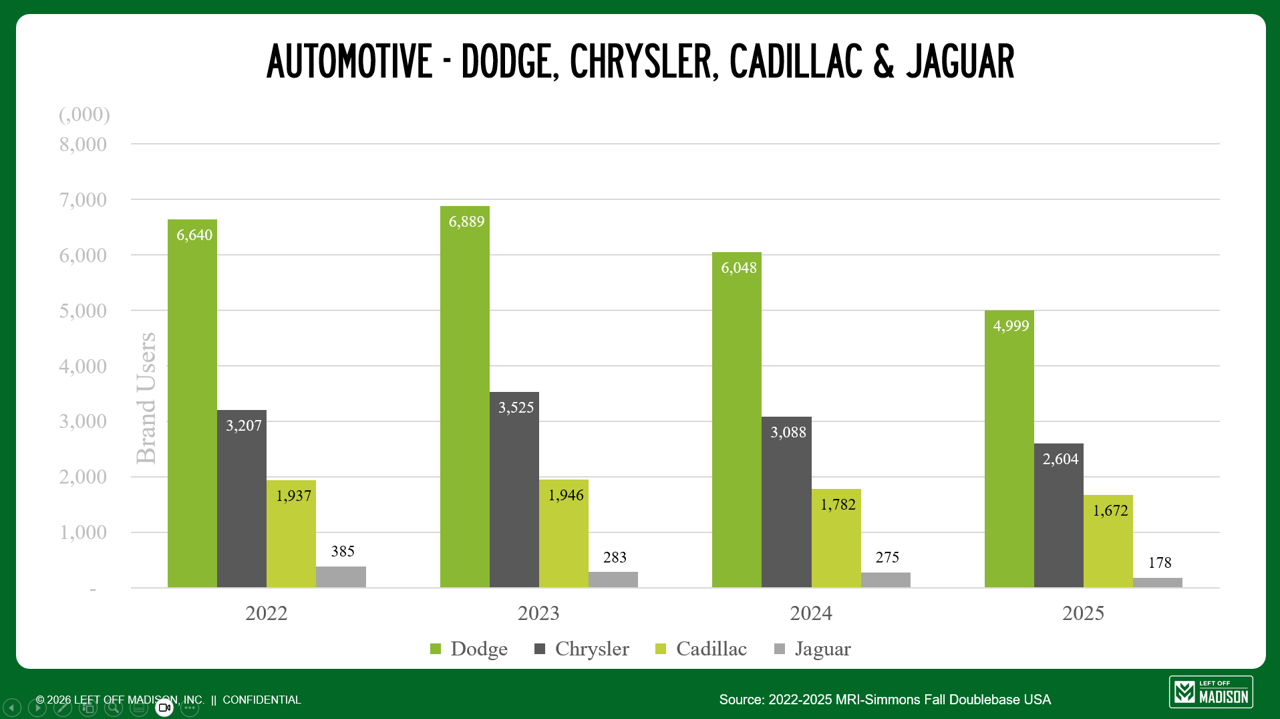


Chrysler may be suffering less from product quality issues and more from what marketers might call the “invisible brand” problem. The brand has operated for years with an aging portfolio, limited innovation headlines, weak cultural conversation, and little emotional distinctiveness in a market increasingly driven by technology, identity, and future-facing relevance.
In automotive, silence is dangerous.
Consumers increasingly want brands that feel like they are actively evolving. Chrysler arguably stopped standing for something culturally distinct, especially among younger buyers entering the category.
Dodge faces a different challenge.
For years, Dodge maintained one of the clearest identities in automotive: raw American muscle, horsepower, aggression, and unapologetic performance culture. But as the industry rapidly shifted toward EVs, software, efficiency, connected ecosystems, and modern luxury expectations, Dodge remained heavily associated with HEMIs, burnouts, and nostalgia-driven performance.
That positioning created tremendous loyalty among existing enthusiasts.
But it may have narrowed broader recruitment over time.
Strong identity is powerful.
Overly narrow identity can eventually shrink penetration.
Cadillac may be the most nuanced case of all because, on paper, Cadillac actually has been highly visionary. The brand invested aggressively into EVs, modern design, performance vehicles, and technology-forward luxury experiences.
The problem may be that consumer perception hasn’t fully caught up.
Brand perception often lags product transformation by years. Cadillac still carries legacy associations for many consumers tied to older luxury buyers and traditional American luxury — even as the company attempts to reposition itself against modern luxury leaders.
Meanwhile, Tesla and Porsche increasingly own the emotional territory of future luxury and cultural status.
Jaguar’s collapse, however, appears more transitional than perceptional.
About a year ago, Jaguar generated enormous attention after announcing its radical shift toward an all-electric ultra-luxury future while simultaneously discontinuing much of its traditional lineup. From a long-term positioning standpoint, the move may ultimately prove smart.
But in the short term, consumers can’t buy what no longer exists.
The broader lesson for marketers is increasingly clear:
Consumers today reward either confidence in the future or confidence in consistency.
Brands struggling to communicate either — especially in culturally shifting categories — are becoming increasingly vulnerable, regardless of legacy awareness or historical equity.
4. Family Restaurants: The Category Is Growing. So Why Are Legacy Chains Collapsing?
At first glance, the family restaurant category appears healthy.
MRI-Simmons data comparing 2025 vs. 2022 shows total users of family restaurants grew by 12.7 million consumers (+7%), while heavy users — diners visiting 4+ times per month — surged by 7.2 million (+13%).
Consumers are still dining out. Frequently.
Which makes the declines at several legacy chains even more revealing.
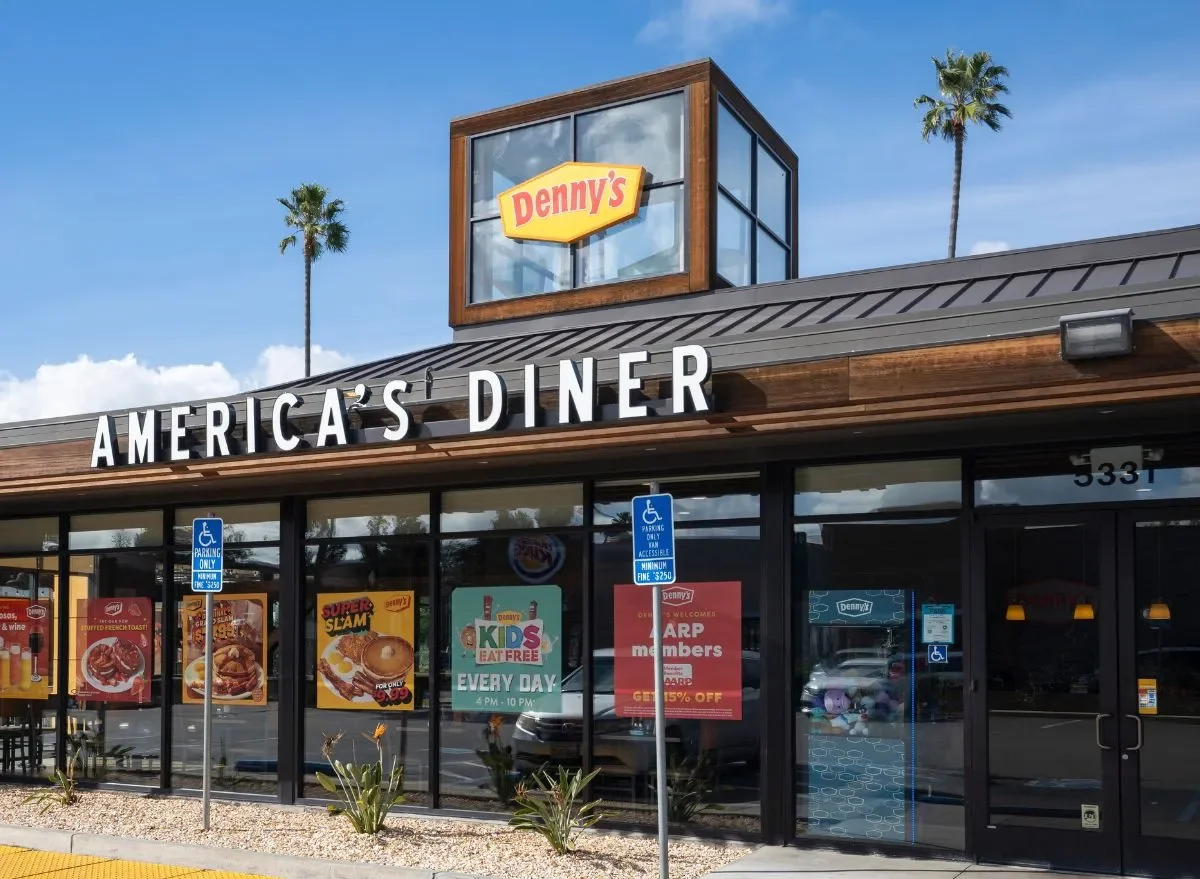
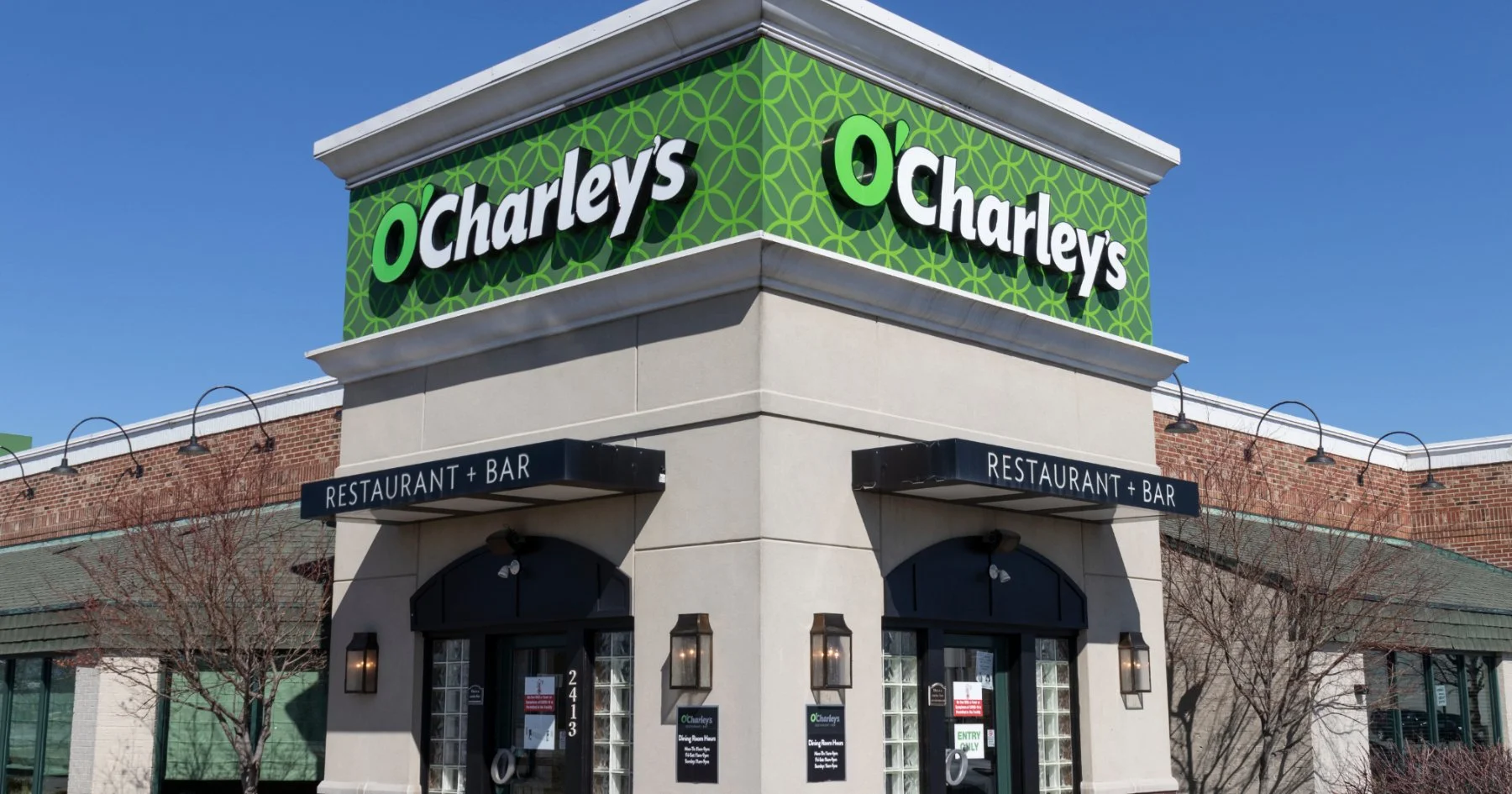
Denny's lost 1.66 million recent diners (-10%). TGI Fridays fell by 1.47 million diners (-25%). O'Charley's lost 43% of its patrons, while Johnny Carino's declined 37%.
The key insight: This is not a category problem.
It’s a relevance problem.
Over the past decade, consumer expectations around dining shifted dramatically. Today’s diners increasingly prioritize:
experience
atmosphere
convenience
customization
perceived freshness
social shareability
local authenticity
fast-casual flexibility
Many legacy family chains were built for a previous era:
suburban traffic patterns
large dining rooms
predictable family occasions
broad middle-America appeal
standardized experiences
But modern consumers increasingly seek places that feel either:
more elevated
more convenient
more culturally current
or more emotionally distinctive
That’s where many legacy chains became vulnerable.
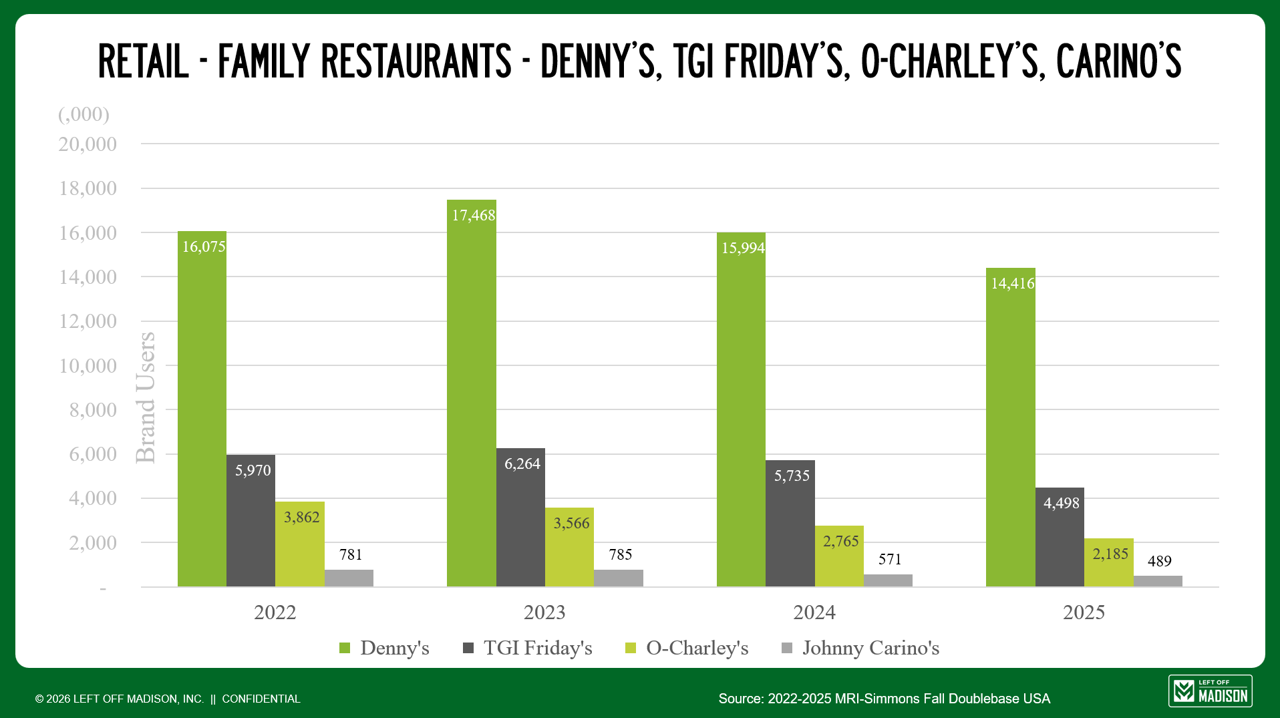

TGI Fridays may be one of the clearest examples. Originally built around energetic bar culture and singles nightlife, the brand later attempted to reposition itself as a family-friendly casual dining chain. But in doing so, it arguably lost some of the distinctiveness that originally made it culturally relevant.
The problem with middle-market repositioning is that brands often become less memorable in the process.
Meanwhile, newer competitors and fast-casual brands captured younger diners through convenience, design, mobile ordering, delivery integration, and more modern social experiences.
Operational issues only compounded the challenge. Falling traffic, debt pressure, store closures, and eventual Chapter 11 bankruptcy accelerated consumer perception that the brand was fading.
O'Charley's faced a different but equally difficult reality. Rising commodity and labor costs collided with demographic shifts that left many of its suburban locations increasingly isolated from younger growth audiences. Like many legacy casual dining chains, O’Charley’s was built around a dine-in behavior pattern that weakened significantly as delivery, convenience culture, and hybrid dining habits expanded.
The result: large physical footprints with declining traffic economics.
Johnny Carino's illustrates how operational instability can rapidly erode consumer momentum. Heavy debt, lease disputes, repeated bankruptcies, ownership changes, and shrinking locations created the kind of uncertainty consumers increasingly interpret as brand decline. Once diners begin assuming a chain is disappearing, household penetration often falls even faster.
Even Denny's — arguably one of the most recognizable names in family dining — appears vulnerable to changing consumer behavior. While still highly familiar, younger consumers increasingly associate value with either convenience-driven fast casual or more premium, experience-led dining occasions. Traditional diner positioning has become harder to sustain in the middle of the market.
That middle ground is becoming increasingly dangerous across consumer categories.
The broader lesson for marketers is important: Category growth no longer protects legacy brands.
In fact, some of the biggest declines now occur inside growing categories.
Because increasingly, consumers aren’t simply choosing places to eat.
They’re choosing experiences, identity signals, convenience ecosystems, and brands that feel aligned with how they live today.
And brands built for previous consumer behaviors are discovering just how quickly those habits can change.
5. Grocery: The Rise Of Curated Consumption
For decades, grocery retail was largely a scale game.
More locations.
More inventory.
More promotions.
More weekly traffic.
But today’s grocery landscape increasingly rewards something very different: Clarity of identity.
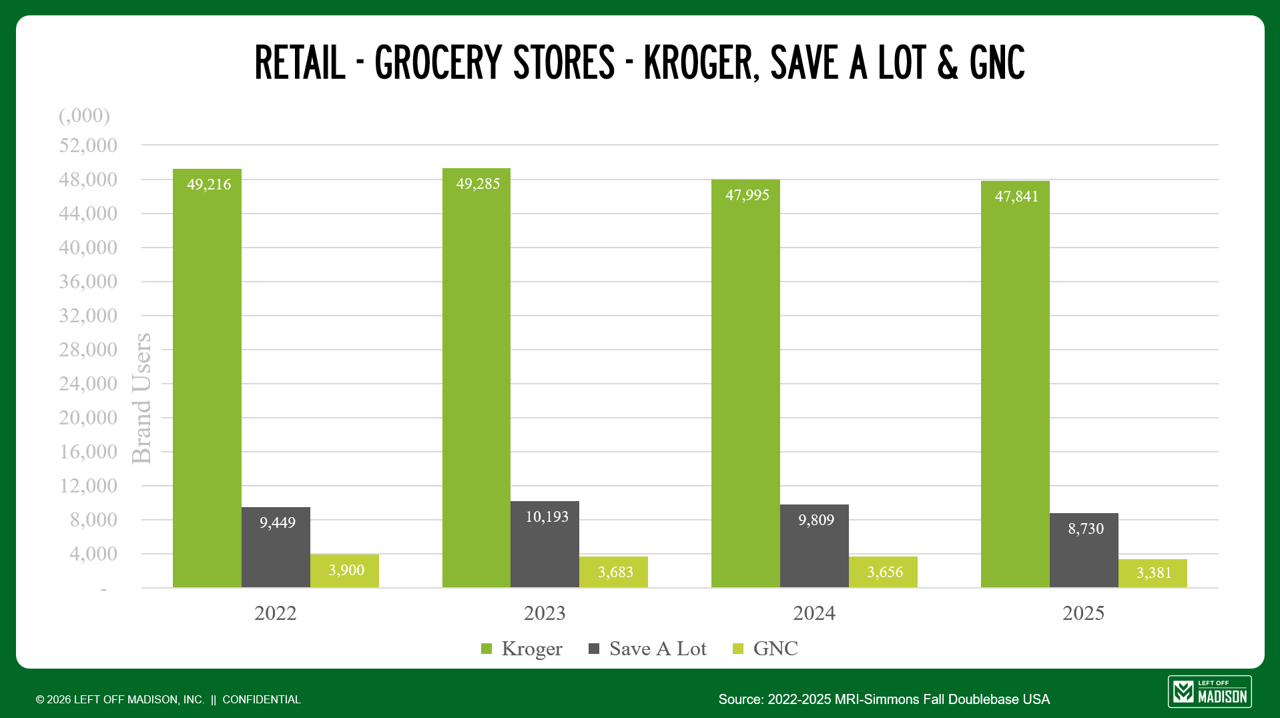
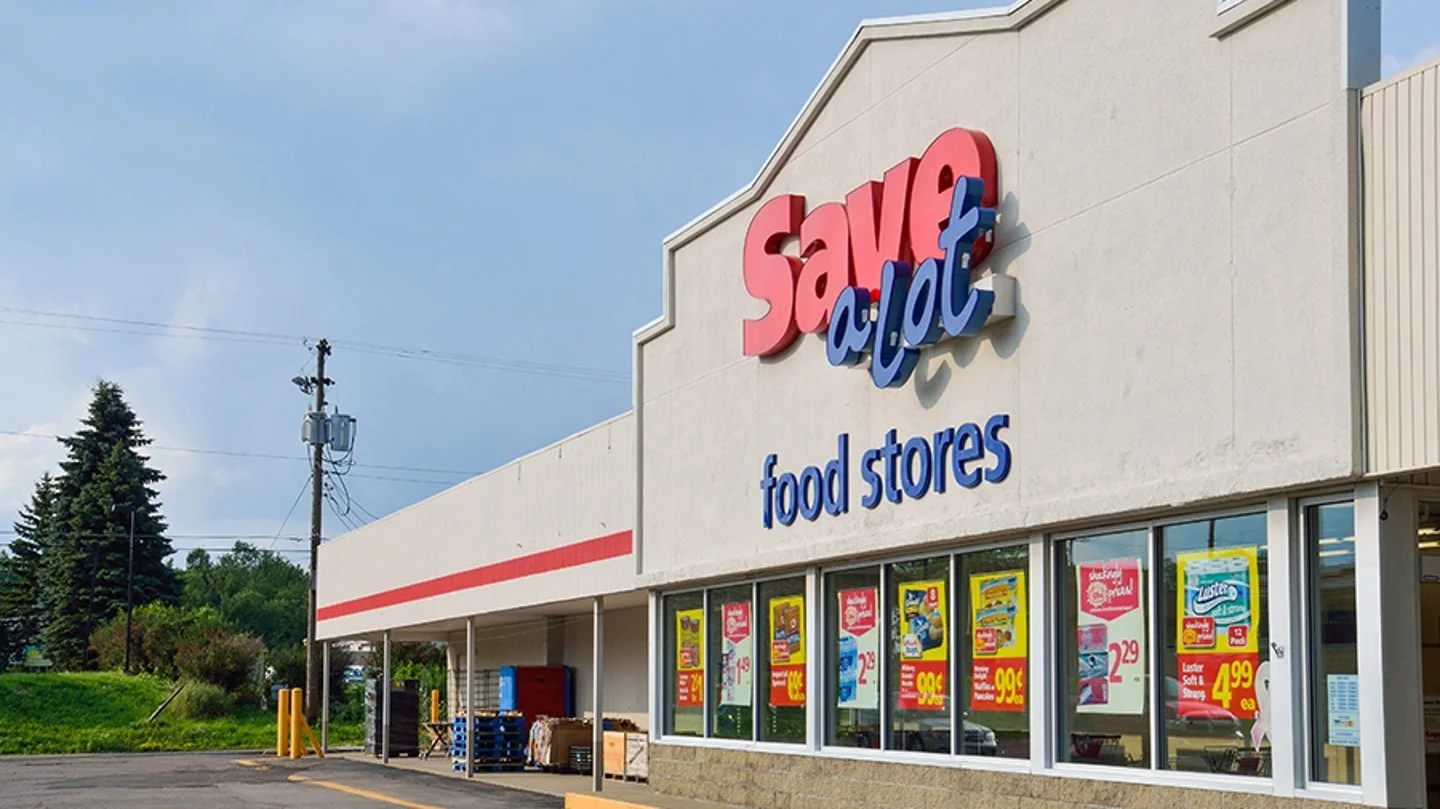
MRI-Simmons data comparing 2025 vs. 2022 reveals notable declines among several established grocery and wellness retailers. Kroger lost 1.37 million shoppers (-3%), while Save A Lot declined by 719,000 shoppers (-8%). Even GNC — while not a traditional grocer — lost 519,000 shoppers (-13%).
Meanwhile, the winners are growing aggressively.
Aldi added a staggering 17 million shoppers (+29%), while Trader Joe's gained 2.27 million shoppers (+8%).
What’s becoming increasingly clear is that consumers no longer simply want grocery stores.
They want grocery experiences aligned with their identity, values, budgets, and lifestyles.


Aldi’s rise reflects more than price sensitivity. The brand has successfully transformed value shopping into smart shopping. In an inflationary economy, Aldi increasingly feels efficient, curated, and emotionally guilt-free — offering consumers a sense of financial discipline without sacrificing quality perception.
Trader Joe’s operates almost from the opposite direction. Its smaller footprint, highly curated assortment, private-label focus, and constantly rotating discoveries create a shopping experience that feels personal, exploratory, and culturally distinct. Consumers don’t just shop there for groceries. They shop there for discovery.
That emotional differentiation matters more than ever. (BTW, Aldi and Trader Joe’s are related.)
By contrast, many traditional grocery chains increasingly risk feeling operational rather than inspirational — large, familiar, convenient, but less emotionally distinctive in a market where consumers increasingly seek alignment with lifestyle and identity.
What caught our attention most, however, were the emerging modern grocery success stories.
Sprouts Farmers Market — which first opened in 2002 and only recently appeared in MRI-Simmons — already shows nearly 15 million recent shoppers. Meanwhile, H Mart, the pan-Asian grocery retailer founded in 1982, now reaches more than 8.3 million recent shoppers.
Neither brand grew by trying to become everything to everyone.
Sprouts capitalized on health-conscious consumers seeking freshness, specialty products, and a more natural-market experience without Whole Foods-level pricing. H Mart, meanwhile, benefited from both growing Asian American populations and broader mainstream consumer interest in global food culture, cooking experimentation, and authentic international ingredients.
Both retailers feel culturally current.
That may be the larger story unfolding across grocery.
The future of retail increasingly belongs to brands with sharper points of view — whether around value, wellness, discovery, culture, or lifestyle alignment.
Because increasingly, consumers aren’t simply buying groceries.
They’re buying reflections of how they want to live.
bonus: 6. Politics: The Rise Of The Politically Homeless
One of the most revealing shifts in recent MRI-Simmons data may have nothing to do with products at all.
It’s identity.
Specifically, political identity.
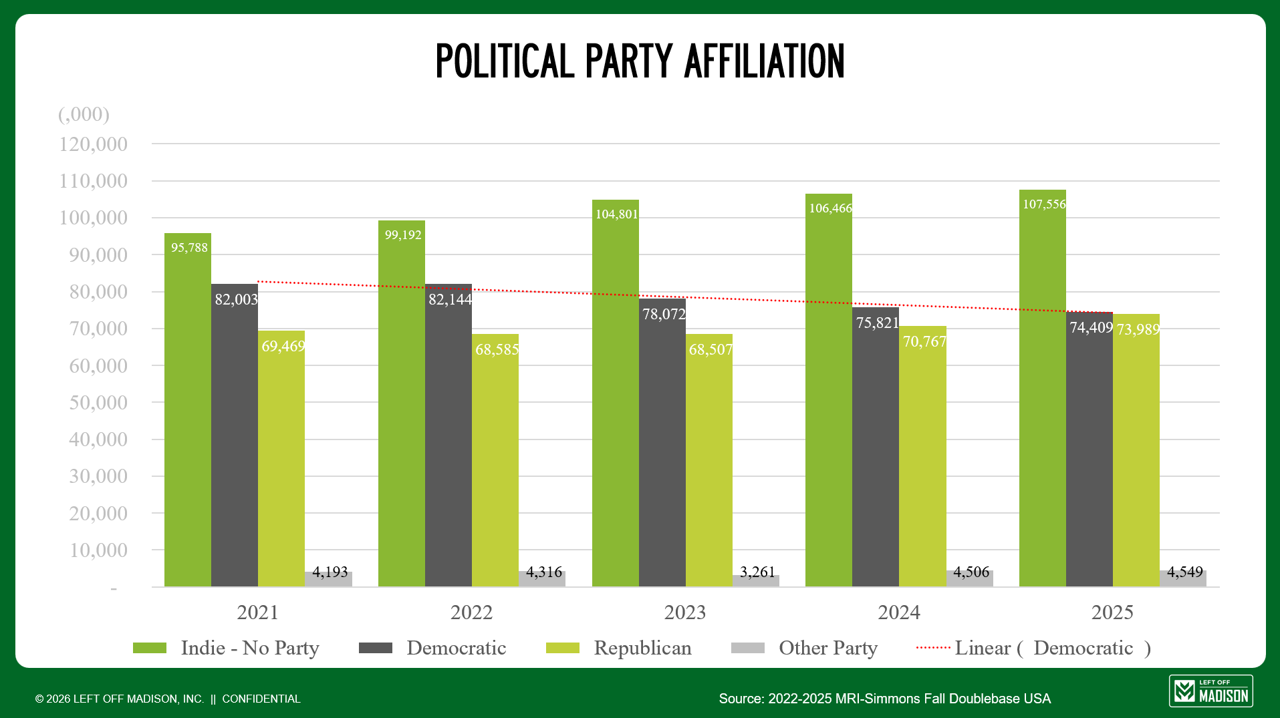
Between 2022 and 2025, Americans self-identifying as affiliated with the Democratic party declined by 7.7 million people (-9%), bringing the total to 31.6 million. Meanwhile, Republican party affiliation grew by 5.4 million people (+8%) to nearly 74 million Americans.
But the biggest story may sit outside both parties.
Americans identifying as Independent or with no party affiliation now total 107.5 million people — by far the largest segment measured.
That audience grew by more than 8.3 million people over the period.
What this suggests is not simply partisan movement.
It suggests growing political exhaustion.
Increasingly, many consumers appear uncomfortable with rigid political identity altogether. Trust in institutions continues eroding. Media fragmentation has intensified ideological fatigue. And younger consumers especially tend to resist labels that feel overly tribal, binary, or institutionally defined.
In many ways, Americans increasingly behave politically the same way they increasingly behave as consumers: fluidly.
Issue by issue.
Moment by moment.
Identity by identity.
That creates enormous volatility — not just for politics, but for brands.
For years, marketers increasingly leaned into overt values-based positioning, assuming consumers wanted corporations to publicly take sides on major social and political issues. In some cases, that created strong emotional loyalty among core audiences.
In other cases, it created consumer fatigue.
The rise of Independents may partially reflect a broader cultural backlash against constant polarization itself. Many Americans increasingly appear less interested in ideological absolutism and more interested in practicality, stability, affordability, and quality of life concerns.
That doesn’t mean values no longer matter.
They absolutely do.
But consumers increasingly reward nuance over rigidity and authenticity over performance.
The larger implication for marketers is significant: The old assumption that cultural alignment automatically creates broader market growth is becoming less certain.
Because today’s consumers are increasingly skeptical of institutions, skeptical of narratives, and increasingly resistant to being told which “side” they belong on.
And that may be reshaping everything from politics to media to brand strategy in real time.
The Bigger Warning Hidden Inside The Data
What makes these trends so important is that most of these brands are not unknown brands.
Many still have:
massive awareness
national distribution
historical equity
operational scale
decades of consumer familiarity
And yet they’re still losing users.
That’s the warning.
Because modern consumer decline rarely begins with awareness collapse.
It begins with relevance erosion.
Consumers stop choosing a brand first.
Then heavy users soften.
Then household penetration weakens.
Then cultural gravity fades.
By the time revenue fully reflects the shift, the market has often already moved on.
The uncomfortable reality for marketers is that consumers today are evolving faster than many organizations are structured to adapt. Categories are fragmenting. Identity signaling matters more. Culture moves faster. Loyalty is weaker. And relevance increasingly has a shorter shelf life.
The brands growing right now are rarely winning by accident.
They are winning because they understand that modern growth increasingly sits at the intersection of:
culture
perception
identity
experience
trust
and emotional meaning
Not simply distribution, scale, or historical dominance.
That may ultimately be the biggest lesson hidden inside the data.
Left Off Madison
The Ad Agency CMOs Call When Growth Is Non-Negotiable
One Agency. Every Capability. Zero Ego.