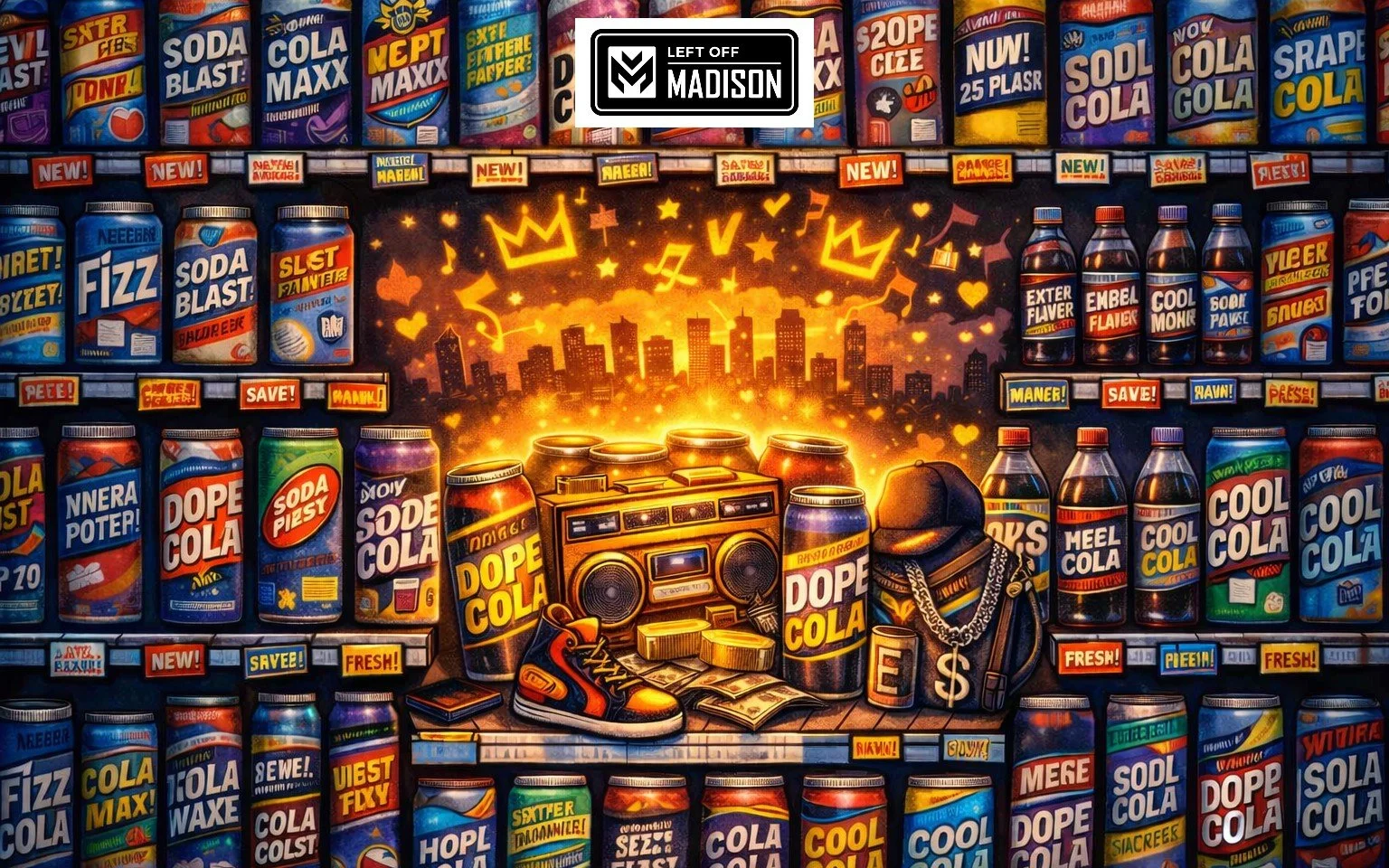
Too many brands still confuse product differentiation with actual brand power.
They think a better feature, a cleaner ingredient list, a sharper price point, or a new piece of innovation is enough to separate them in-market. Sometimes it helps. Briefly. But in most crowded categories, that advantage has a shelf life of about five minutes.
Because competitors copy features.
They match claims.
They mimic language.
They close the gap.
What they cannot easily copy is emotional meaning.
That is the real divide between brands that generate short-term interest and brands that build lasting demand.
Product differentiation is about what the product does.
Emotional differentiation is about what the brand makes people feel, signal, express, or believe.
One gets you onto the list.
The other gets you chosen.
And in categories drowning in parity, chosen is what matters.
The mistake brands keep making
Most marketers still overinvest in rational distinction because it feels safer. It is easier to present in a deck. Easier to quantify. Easier to defend in a meeting.
“This one is faster.”
“This one is cleaner.”
“This one has more protein.”
“This one has less sugar.”
“This one costs less.”
“This one has a new ingredient.”
Fine.
But consumers are not standing in the aisle, scrolling their phones, or watching ads with the time or energy to forensically evaluate every functional nuance. They are making fast decisions in a world of overload. Which means brands that win tend to have something stronger than product superiority.
They have emotional clarity.
They know what they mean in people’s lives.
Functional advantage is often a temporary tactic
This is the part many brands do not want to admit: product differentiation is frequently a short-term tactic, not a long-term moat.
That does not mean product truth is irrelevant. It matters. It gives the brand substance. It provides proof. It can create a point of entry.
But unless that truth is turned into emotional relevance, it usually stays trapped at the level of information.
And information alone rarely drives durable preference.
Emotion does.
Emotion creates memory.
Emotion creates affinity.
Emotion creates shortcuts.
Emotion justifies premium pricing.
Emotion keeps a brand from becoming interchangeable the second the market catches up.
That is not soft branding fluff. That is commercial leverage.
Ajinomoto Gyoza: don’t sell the dumpling, sell the moment around it
Ajinomoto Gyoza could have easily gone to market as just another “authentic” dumpling or potsticker in a packed field of frozen competitors. But for many non-Asian American shoppers, authenticity in this context is vague at best. It is not a strong enough growth story on its own.
So the work did not stop at product credentials.
Instead, it created emotional differentiation around the sociability, fun, and entertainment of making and sharing these dumplings. The product became more than an item in the freezer case. It became a reason to gather, snack, host, and participate.
That is a much bigger idea than “these are high-quality dumplings.”
The result: exploding sales and new distribution channels.
That is what happens when the emotional meaning is bigger than the product claim.
(View the full case study [ HERE ].
7UP: personality became the point of difference
When 7UP needed to be re-staged, it faced a familiar problem: no meaningful functional differentiation versus Sprite, while Mountain Dew and Sprite each occupied stronger cultural territory.
So it would have been pointless to pretend lemon-lime soda itself was suddenly a fascinating innovation story.
Instead, the brand pivoted into irreverence, humor, and fun, with a smart nod to the old “Uncola” spirit. “Make 7UP Yours” did not win because the liquid changed. It won because the brand became emotionally fresher, culturally sharper, and more enjoyable to spend time with.
The result was a significant rebound in sales and volume growth, with the campaign running for years.
That is what emotional differentiation does. It gives people a reason to care when the product alone cannot.
(View the full case study [ HERE ].
Hawaiian Punch: the icon existed, culture made it powerful
Hawaiian Punch had a clear growth challenge: it needed to move beyond a mom-driven pantry purchase and connect with younger consumers more likely to buy the 20-ounce bottle.
A product-led strategy would not have been enough.
But Hawaiian Punch had a real asset: Punchy.
The opportunity was to embed that icon into multicultural youth culture shaped by fashion, swagger, and hip hop. Through limited-edition apparel, music videos, and cultural integration, the brand stopped behaving like a legacy juice drink and started showing up like something with relevance and attitude.
That is emotional differentiation.
Not just taste.
Not just packaging.
Not just convenience.
Identity.
And that identity helped drive meaningful sales and volume growth.
(View the full case study [ HERE ].
Just Bare Chicken: in a commodity category, confidence was the differentiator
Chicken is one of the easiest categories in the world to make sound generic. Better farms. Better standards. Better quality. Better-for-you. Natural. Cleaner. More wholesome. It all starts to blur.
Just Bare needed a stronger path.
So rather than try to out-claim everyone else in a commoditized lane, the brand tapped into a growing cultural desire: people wanting to know more about where their food comes from.
That shift mattered because it changed the message from product superiority to emotional reassurance.
Not just:
“This is premium chicken.”
But:
“This is a food choice you can feel smart and confident about.”
That is emotional differentiation built on a real consumer tension.
The result: rapid sales and expanded distribution across retail chains, club stores, and Amazon Fresh Direct. Today, the trademark generates over $1 billion in sales.
(View the full case study [ HERE ].
DnL: when the product logic is weak, emotion can still create demand
dnL is one of the clearest examples of why rational product logic is not always the hero.
The product itself was highly caffeinated, aggressively lime, leprechaun green, and visually jarring. It had no especially elegant functional reason for being, and the green color itself could actually repel trial.
So rather than force a fake product story, the brand leaned into emotional territory: discovery, flipped perspectives, games, and playful inversion.
The result was not modest. It drove eye-opening trial and sales growth and sustained a run of roughly five years.
That is the lesson too many marketers miss: when the product gives you very little to romanticize, the emotional world around it can still create momentum.
(View the full case study [ HERE ].
Sunkist: caffeine was the feature, “charged experiences” was the brand
Sunkist had a usable product truth: strong caffeine levels.
But that fact by itself was never going to rejuvenate the brand.
So the smarter move was to transform caffeine from a formula detail into an emotional platform. “Charged experiences” gave the brand access to something bigger: ambition, possibility, mentorship, and life-moving opportunities for young people.
That is how brands escape feature fatigue.
The product truth stayed intact.
But the emotional meaning gave it lift.
That is the difference between saying what is in the can and explaining why it matters.
(View the full case study [ HERE ].
What creative should actually do
Too much advertising still stops at the product demo.
It shows the thing.
States the benefit.
Adds a line.
Calls it strategy.
That is not enough.
Creative’s job is not just to display the product. It is to translate product truth into human meaning.
Not: “This car has automatic braking.”
But: “This car helps protect your family.”
Not: “This food is sourced carefully.”
But: “This is a choice you can feel better making.”
Not: “This drink has caffeine.”
But: “This brand is about energy, momentum, and what comes next.”
That is where growth starts to happen.
The business reality
Product differentiation can help get a brand considered.
Emotional differentiation is what earns preference, loyalty, pricing power, and repeat choice.
In mature categories, that is the real battleground.
Because products are copied.
Claims are commoditized.
Features flatten.
Parity spreads.
Emotion is harder to clone.
That is why the smartest brands do not ask only, “What makes our product different?”
They ask, “What does our brand mean that others cannot easily imitate?”
That is the question that separates short-term marketing from long-term brand growth.
And it is the one more marketers should be asking.
This article is dedicated to our creative director, Ritch Goldstein, who is a master of sorts to bring emotion to brands and catapult them into furious growth.