Your Attribution Stack Is Lying to You
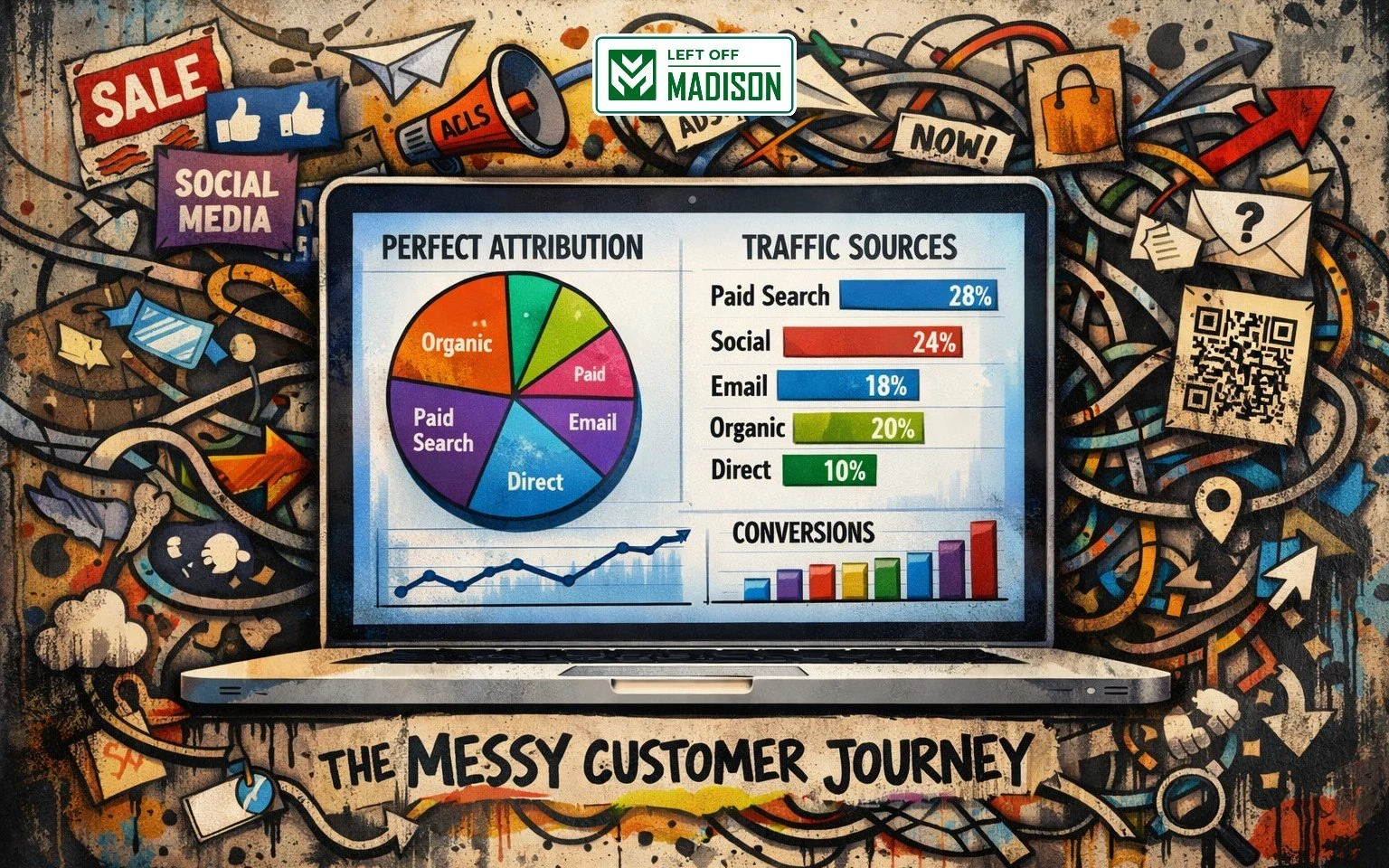
Too many marketers are looking for a single source of truth that does not exist.
They want one dashboard. One platform. One report that tells them, with satisfying precision, exactly what drove the sale. So they turn to Shopify. Or HubSpot. Or Amazon. Or whatever platform sits closest to the transaction and offers the cleanest-looking numbers.
And then they make a mistake.
They stop treating those tools as useful inputs and start treating them as truth.
That is where attribution starts to go sideways.
Because closed-platform reporting is not fake. It is just incomplete.
Yes, there are more sophisticated enterprise-level solutions built to provide deeper analysis across larger, more complex ecosystems. Platforms such as Adobe Analytics Attribution IQ or Google Analytics 360 can offer far more robust capabilities than Shopify, HubSpot, or Amazon-native reporting. But those tools typically sit in a different class altogether — often requiring enterprise budgets, specialized implementation, and a level of organizational maturity that many small and mid-sized marketers simply do not have. For many brands, that means six-figure annual investment territory before staffing and activation are even considered.
That distinction matters.
Because the moment a marketer starts believing any one platform is delivering the full picture, that platform stops being a reporting tool and starts becoming a filter on reality.
At Left Off Madison, we believe growth beats optics. And attribution dashboards can create some of the most seductive optics in all of marketing: neat channel splits, tidy conversion paths, apparently decisive winners and losers, and just enough precision to make everyone feel smarter than they really are.
But if your reporting environment can only see part of the journey, then your confidence should be proportional to that limitation.
Too often, it is not.
The fantasy of perfect attribution
The fantasy is understandable.
Marketers are under pressure. Finance wants proof. Leadership wants answers. Sales teams want credit. Agencies want accountability. Platforms want to show impact. Everyone wants the comfort of saying, “This is what worked.”
So when a platform gives them a report that appears to answer that question, they latch onto it.
Shopify says a sale came from one place. HubSpot credits another sequence of interactions. Amazon shows what influenced an on-platform purchase. The dashboards are clean. The percentages are convincing. The model outputs feel authoritative.
And for larger organizations, enterprise systems such as Adobe Analytics Attribution IQ or Google Analytics 360 can certainly deepen the analysis. But even those are not magic. They are still measurement systems shaped by tagging, identity resolution, configuration, governance, and interpretation. Expensive does not mean omniscient.
Attribution is never just about what a tool reports. It is about what that tool can see, what it cannot see, and how it decides to assign credit to what it did see.
That is a very different thing.
A platform can be useful without being comprehensive.
It can be informative without being definitive.
It can be directionally valuable while still being structurally incomplete.
That is the mindset too many marketers lose.
Closed platforms are designed to answer their question, not every question
This is where marketers need to get more disciplined.
Every platform measures from a particular vantage point.
Shopify is built to help merchants understand commerce activity around their store. HubSpot is built to help teams understand tracked interactions across CRM, marketing, and sales workflows. Amazon Attribution is built to show how off-platform marketing affects on-platform shopping behavior. Adobe Analytics Attribution IQ and Google Analytics 360 sit higher up the sophistication ladder, but even they are ultimately frameworks for interpreting observed behavior, not crystal balls.
And yet many brands still behave as though one reporting environment — whichever one they happen to log into most often — should be treated as the final authority.
They pull a report from one environment and start making sweeping budget decisions from it.
They shut off channels too quickly.
They overfund channels that happen to claim credit well.
They underinvest in channels that influence demand but do not capture it cleanly.
They confuse traceability with importance.
That last one is especially dangerous.
Because in modern marketing, the things that are easiest to track are not always the things doing the most important work.
The bottom of the funnel has stolen too much authority
A lot of attribution delusion comes from a deeper bias inside modern marketing:
We overvalue what happens closest to conversion.
Why?
Because it looks cleaner. Feels safer. Sounds more accountable in a meeting.
A branded search click gets credit.
A retargeting ad gets credit.
A marketplace interaction gets credit.
An email click gets credit.
Meanwhile, the things that often made those touches more effective in the first place — awareness, memory, creator exposure, word of mouth, previous ad exposure, broader brand familiarity, retail presence, earned conversation, pricing context, even a friend’s recommendation — often do not show up with the same clarity.
So marketers start over-trusting the last visible hand on the steering wheel.
That does not mean lower-funnel reporting is useless. It means it is often over-empowered.
At Left Off Madison, we see this all the time: brands cutting or starving the very upstream work that improves conversion later, simply because the upstream work does not receive neat enough credit inside the platform they happen to be staring at.
That is not disciplined measurement.
That is measurement bias dressed up as rigor.
Shopify is not your marketing brain
This is especially common in e-commerce.
A brand looks at Shopify and starts treating it as the final authority on what drove the sale.
That is too much faith to place in a platform built primarily to help merchants run and understand commerce activity within its own ecosystem.
Shopify can be useful. Very useful. But it is not your marketing brain.
It can understate channels that introduce demand rather than close it.
It can miss or flatten influences that occur off-platform or outside clean click-based paths.
It can create false confidence when leadership wants a simple story.
And that is before you get into the real world, where people move across devices, clear cookies, use privacy tools, encounter brands in dark social environments, hear about products from friends, search later, buy later, or show up as “direct” when they were anything but direct.
If you run your whole budget strategy through a tool that mostly rewards what it can most easily observe, do not be surprised when your media mix slowly starts to favor the observable over the influential.
That is how brands drift into attribution delusion.
HubSpot is helpful. It is not omniscient.
HubSpot has a different flavor of the same problem.
It is a strong system for organizing tracked interactions across CRM and marketing operations. But it is still limited by the interactions it records, the model selected, and the environment in which it operates.
Put bluntly: if you change the model, you can change the story.
That should sober people up.
The goal of attribution should not be to pretend one model is reality. The goal should be to understand how different models illuminate different parts of the journey, while keeping enough judgment to know that none of them equals the whole truth.
Too many marketers skip that second part.
They let the report become the decision-maker.
Amazon can tell you about Amazon. That does not mean it can tell you everything.
Amazon Attribution is useful for a specific question: how non-Amazon efforts influence shopping activity on Amazon.
That is valuable.
But the scope is the point.
It is telling you about how marketing affects Amazon outcomes. It is not a universal map of brand influence across all commerce behavior everywhere. It is one lens into one environment.
And yet plenty of marketers treat marketplace reporting as though it were the final answer to demand generation.
That is a mistake.
Because a consumer might buy on Amazon after being influenced by months of exposure elsewhere. Or they might buy on your site after researching on Amazon. Or they might encounter your brand in stores, on social, through creators, through search, through email, through a friend, and only later convert in the environment that receives the most visible credit.
The transaction location is not the same thing as the influence hierarchy.
That is one of the biggest attribution traps in modern commerce.
The real problem is not bad tools. It is lazy interpretation.
Let us be fair.
The problem is not Shopify.
It is not HubSpot.
It is not Amazon.
It is not GA4.
It is not Adobe Analytics.
It is not GA360.
The problem is how eagerly marketers want a neat answer to a messy question.
Attribution is hard because human behavior is hard.
People do not move in straight lines. They do not leave perfect breadcrumbs. They do not always click where they were influenced. They do not always buy where they were persuaded. They do not always convert when the dashboard expects them to.
So when marketers let one platform’s reporting logic dictate the entire strategy, what they are really doing is outsourcing judgment.
And at Left Off Madison, we do not believe platforms should replace judgment. We believe judgment beats process — especially when the process is pretending to be more complete than it is.
What smarter marketers do instead
Smart marketers do not abandon attribution.
They stop worshipping it.
They treat platform reporting as one input, not the verdict.
And they also recognize the difference between what is ideal and what is practical.
Yes, an enterprise can invest in Adobe Analytics Attribution IQ or Google Analytics 360 and build a more advanced measurement infrastructure. But most brands are not sitting on that kind of budget, internal support, or implementation discipline. Many small and mid-sized marketers are trying to solve attribution with a much messier, more affordable stack.
That is fine.
Because what they really need is not perfection.
They need a decision system.
A way of triangulating truth from multiple incomplete but useful inputs.
They compare models instead of clinging to one.
They use UTMs with real discipline.
They look at pathing, timing, and lift, not just claimed conversion credit.
They ask what is directionally true across multiple sources.
They study household penetration, repeat rate, branded search movement, direct traffic movement, conversion quality, geographic lift, and holdout performance.
They look for patterns, not fantasies.
That is a much more mature way to operate.
The zero-dollar discipline many brands still ignore
A lot of smaller and mid-sized brands assume they need an expensive enterprise stack before they can behave intelligently.
They do not.
What they often need first is rigor.
Clean UTM governance.
Consistent naming conventions.
Stronger use of GA4’s attribution and pathing capabilities.
A “How did you hear about us?” field to capture dark social and offline influence.
Simple incrementality tests by geography or audience.
Basic correlation analysis between spend changes and revenue or direct traffic movement.
Those are not glamorous. But they are often more revealing than blindly trusting whatever neat channel pie chart a platform spits out.
The brands that grow are usually not the ones with the prettiest dashboards.
They are the ones disciplined enough to ask whether the dashboard is telling only the part of the story it happens to be able to see.
The takeaway
Your attribution stack is probably not lying because it is broken.
It is lying because you are asking it to tell the whole truth from one angle.
And no closed platform can do that.
Shopify can help.
HubSpot can help.
Amazon can help.
Adobe Analytics Attribution IQ can help.
Google Analytics 360 can help.
But none of them should be mistaken for the final authority on what really drives growth.
That is the delusion.
Because once marketers confuse partial visibility with total truth, they start optimizing for what is easiest to credit rather than what is most important to build.
And that is how brands slowly talk themselves into weaker strategy with stronger dashboards.
The smart move now is not to find a new tool and hope it finally solves attribution forever.
It is to grow up.
Use the tools.
Respect their limits.
Triangulate the signals.
Test what matters.
And keep enough judgment in the room to remember that just because a platform can assign credit does not mean it fully understands cause.
That is not anti-data.
That is what grown-up marketing looks like.