Starbucks Forgot Why People Stayed. Local Coffeehouses Didn’t.
The lesson for brands: protect the experience that makes customers choose you.
By Rob Douglas, Co-founder & CEO, Left Off Madison
There’s something revealing about a strategy called “Back to Starbucks.”
The word “back” suggests there was something worth returning to. A way of doing business. A relationship with customers. An experience that became less central as other priorities took over.
That’s what caught my attention in ADWEEK’s recent coverage of Starbucks and its effort to reclaim its brand promise.
I’ve spent more than three decades in advertising. When a company talks about reclaiming its promise, I want to know what customers will actually experience differently when they walk through the door.
Especially when I can walk into a local coffeehouse and see that promise being delivered already.
Starbucks helped make a particular experience familiar to millions of people: good coffee, a welcoming place to sit, a barista you recognized, and permission to stay awhile. The coffee gave you a reason to enter. The experience gave you a reason to return.
My argument is that Starbucks weakened part of that distinction— and gave local operators an opening.
The decline was real. So is the recovery.
The financial record shows a difficult stretch.
In fiscal 2024, Starbucks’ U.S. comparable-store sales fell 2%, with comparable transactions down 5%. In the fourth quarter alone, U.S. transactions fell 10%. That was a substantial drop in visits at comparable stores. [1]
In fiscal 2025, U.S. comparable-store sales fell another 2%, and transactions declined 4%. Companywide GAAP operating margin fell from 15.0% to 7.9%. Restructuring costs, inflation, labor investments and weaker operating leverage all contributed to that margin decline. [2]
Those numbers support a story about customer traffic and profitability under pressure. They do not establish that a loss of differentiation caused every problem. Total revenue still grew in both years.
And the latest results matter. In the third quarter of fiscal 2026, U.S. comparable-store sales increased 7.9%, with transactions up 4.2%. Starbucks reported its fourth consecutive quarter of global comparable-sales growth. [3]
Calling that an uninterrupted collapse would ignore the evidence.
The more interesting question is what Starbucks is trying to recover— and why it needed recovering in the first place.
The chairs tell a story
CNN’s October 6 report on smaller Starbucks stores deserves a careful reading. The new format retains seating and is intended to support a coffeehouse experience in less space. Smaller does not automatically mean less welcoming. [4.]
The telling detail concerns what happened earlier. CNN reported that, before Brian Niccol’s arrival, Starbucks had removed 30,000 comfortable seats, installed hard stools and blocked electrical outlets as it increasingly catered to mobile-order pickup.
You can understand the operational appeal of moving more orders through a store. You can also understand what a customer might conclude when the comfortable chair disappears.
Every operating decision communicates something.
A place to sit communicates that your presence is welcome. A familiar barista creates continuity. A room where neighbors meet gives the location a role in their lives.
Starbucks now explicitly says it is restoring seating and bringing more local character into its stores. That strikes me as an acknowledgment of how much those details matter.
The danger for any brand is that an efficiency gain can weaken the very experience that made customers willing to pay a premium.
On Long Island, the experience never needed a comeback campaign
I’ve been watching Sal Gervasi and his partners build their network of Bean coffeehouses, including Babylon Bean, Bay Shore Bean and Sayville Bean.
Sal is a friend of our agency. From my visits and conversations with him, what stands out is the attention to the whole experience: sourcing and roasting coffee, providing room to sit, building relationships between staff and regulars, and offering food and other beverages that fit how people use the shops.
There are community events, charity involvement and local artwork. These are practical ways to become part of a neighborhood’s routine.
There is also an ownership story worth paying attention to. Greater Long Island reported that Andrew Bell progressed from working at the Bean to becoming a co-owner of its Sayville location. The reporting describes a broader approach of helping employees become store owners. [6]
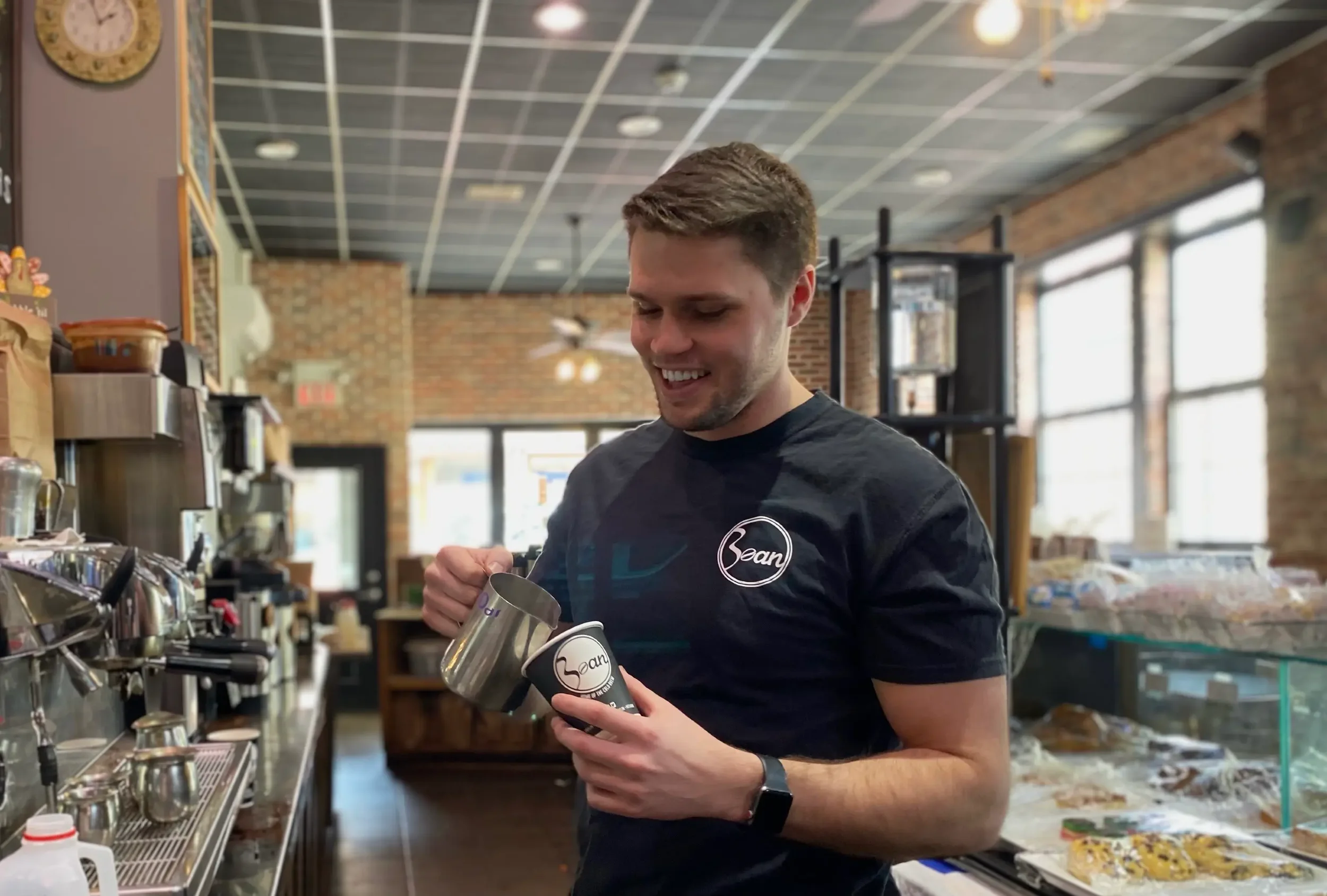
Sayville Bean’s co-owner, Andrew Bell
That creates the possibility of a particularly direct connection between the person serving you, the success of the shop and the community around it.
And where did the Sayville Bean partners choose to open? A former Starbucks location. [6]
That fact alone does not prove the Bean took Starbucks’ customers or outperformed its sales. It does make the competitive question concrete: can another operator create a compelling coffeehouse experience in a space Starbucks left behind?
Sal tells me three more stores are in the pipeline and that the team is seeking a larger warehouse to expand roasting capacity. Those are plans he has shared with me, rather than independently verified financial results.
I haven’t audited the business. A busy shop and an expansion plan cannot establish the health of an entire category. But what I’ve observed is a useful example of operators continuing to invest in the things customers value about a local coffeehouse.
Differentiation has to survive contact with operations
The fact that a competitor can make good coffee does not mean Starbucks has no differentiation. Its scale, familiarity and convenience still matter.
But a local competitor only needs to become the preferred choice in the neighborhood it serves.
It can learn customers’ names. Give them a comfortable place to meet. Put a local artist’s work on the wall. Help an employee become an owner. Build a relationship that makes the next visit feel natural.
For marketers, that should raise a bigger question: how many of the decisions shaping the brand experience are being made without considering what customers actually value?
The seating plan. Staffing levels. Time available for a conversation. Product quality. The way a complaint gets resolved. All of those decisions influence whether the promise in the advertising feels true.
Starbucks may succeed in its return to the coffeehouse. Its recent results deserve acknowledgment. But the local competition has had time to build habits and relationships of its own.
“Back to Starbucks” is a promise the company must keep earning, one visit at a time.
Nike offers a parallel. Its push toward direct sales came with an overemphasis on digital revenue and strained relationships with retail partners. Elliott Hill’s own diagnosis also pointed to a loss of focus on sport, product newness and brand storytelling. These were problems Nike had helped create through its own decisions. [7]
To me, the connection is clear: a brand can become so focused on how it wants to sell that it loses touch with why people want to buy. Whether it’s a coffeehouse experience or the products and retail relationships that connect a sports brand to athletes, the foundations of preference deserve protection.
The lesson extends well beyond coffee: before you optimize an experience, understand which parts make customers choose you.
Some of the things that look inefficient on a spreadsheet are the reasons people come back.
Disclosure: Sal Gervasi is a close friend of Left Off Madison. We are in discussions about a potential joint venture to build an e-commerce coffee business as part of our agency’s expansion into products of our own. The venture has not launched, yet. That relationship gives me a close view of his approach and a prospective commercial interest in its success.
Sources
Starbucks: Q4 and full fiscal year 2024 results, October 30, 2024
CNN, via KESQ: “Exclusive: At Starbucks, the future looks smaller,” October 6, 2026
Starbucks: “Starbucks coffeehouse designs enter a new era,” September 5, 2025
Greater Long Island: “The Bean Coffee House announces fifth location, this time in Sayville”
Retail Dive: “Nike CEO: Wholesale partners feel we’ve turned our back on them,” December 20, 2024
Research checked October 8, 2026. Fiscal-year and quarterly figures above refer to different reporting periods and are labeled accordingly.