The CMO Is Not Being Eliminated. Wasteful Marketing Is.
Why the next generation of marketing leaders will need to think more like CFOs — and why bloated agency models should be nervous.
By Robert Douglas
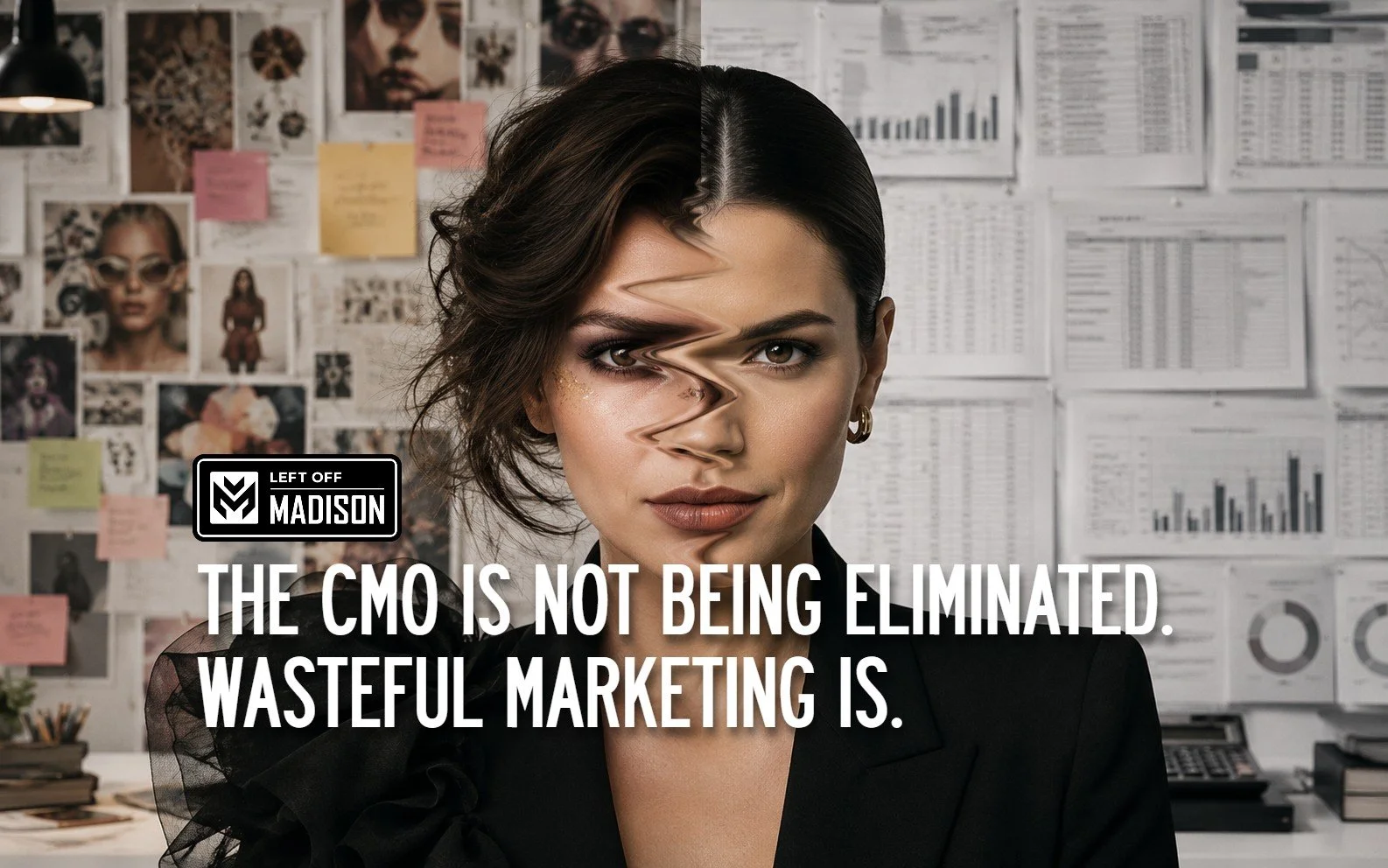
There is a warning shot being fired across the marketing industry.
It is not subtle.
It is showing up in boardrooms, earnings calls, executive restructurings, agency reviews and C-suite org charts.
The traditional CMO role is under pressure.
Not because marketing no longer matters.
Because marketing matters too much to be managed like a department that spends money, makes decks, oversees campaigns and hopes the business eventually notices.
Today’s CEOs, CFOs and boards are asking a much harder question:
Does marketing create measurable business growth — or does it simply consume budget?
That question is changing everything.
And for many incumbent CMOs, senior marketers and legacy agency partners, the answer may be deeply uncomfortable.
The CMO title is already under pressure
According to Forrester’s 2025 research, average Fortune 500 CMO tenure declined from 4.1 years in 2024 to 3.9 years in 2025. More than 20% of Fortune 500 companies changed marketing leadership in the past year, and only 58% had a C-level marketing executive reporting directly to the CEO, down from 63% in 2024.
That does not mean marketing is disappearing.
It means the C-suite is redesigning the role.
In many companies, the job once called “CMO” is being absorbed into broader commercial, customer, growth, operating, brand, revenue or strategy roles.
The message is clear:
The person responsible for marketing can no longer be just a brand steward. They must be a business operator.
General Motors: from CMO to Chief Growth Officer
General Motors is one of the clearest examples of how the marketing mandate is being reframed.
Norm de Greve joined GM in 2023 as CMO. He later transitioned into the role of chief growth officer, a broader title that says a great deal about where large companies are taking marketing accountability. In 2026, de Greve announced he would leave GM in June, saying he had helped deliver “the largest and fastest marketing transformation in GM’s history,” with every brand stronger, consideration up across every brand, and every brand hitting sales records.
That is not traditional brand stewardship language.
That is growth language.
It connects marketing to consideration, brand strength, sales and enterprise transformation. It is the kind of language CEOs and CFOs understand.
But the broader point is not whether one executive leaves or stays.
The broader point is that GM did what more companies are doing: it reframed marketing around growth.
When the marketing leader’s title becomes “chief growth officer,” the expectation changes.
The job is no longer simply to make the brand famous.
The job is to make growth more likely, more measurable and more efficient.
McDonald’s: marketing becomes customer experience
McDonald’s offers another signal.
In early 2025, Tariq Hassan stepped down as McDonald’s USA marketing chief, and Alyssa Buetikofer, then CMO of McDonald’s Canada, was named Senior Vice President, Chief Marketing and Customer Experience Officer of McDonald’s USA.
That title matters.
Not just marketing.
Marketing and customer experience.
Because in a business like McDonald’s, the brand is not only what people see in a campaign. It is price perception. App experience. Ordering friction. Wait time. Value architecture. Menu innovation. Loyalty. Promotions. Franchisee economics. Store execution. Traffic.
And McDonald’s has had real business pressure.
In Q1 2025, McDonald’s reported a 3.6% decline in U.S. comparable sales, its steepest U.S. same-store sales drop since the height of the pandemic. Revenue fell 3% year over year to $5.96 billion, missing analyst expectations.
By Q3 2025, McDonald’s rebounded, with global comparable sales up 3.6%, U.S. comparable sales up 2.4%, consolidated revenue up 3%, and systemwide sales up 8%. But the recovery was driven by the kind of marketing that is deeply connected to business mechanics: value, higher check, the Snack Wrap relaunch and Extra Value Meals.
That is the new marketing reality.
The CMO cannot sit apart from pricing, menu, digital, traffic, loyalty and customer behavior.
The marketer has to understand the business model.
Because the work is no longer just “What is the campaign?”
It is:
What will bring people in?
What will they buy?
What will they spend?
What will bring them back?
What does the franchisee need?
What does the CFO need to believe?
Starbucks: brand, operations and turnaround are now inseparable
Starbucks may be the most visible example of marketing being pulled directly into business transformation.
When Brian Niccol became CEO, he moved quickly to restructure leadership and refocus the company around what became the “Back to Starbucks” plan. In October 2024, Starbucks appointed Tressie Lieberman, formerly of Chipotle and Yahoo, as its first global chief brand officer. Her role was designed to bring clearer accountability to the company’s brand experience, with oversight that connected marketing, product development and data analytics.
That move came amid declining sales and a broader turnaround effort.
In fiscal Q1 2025, Starbucks reported global same-store sales down 4%, with North America also down 4%. Niccol’s turnaround included simplifying the menu, improving service speed, reintroducing ceramic mugs and condiment bars, and restoring the coffeehouse experience.
Starbucks later reported a 1% global same-store sales decline in Q2 2025, with U.S. sales also down 1%, while the company reduced reliance on promotions and loyalty programs in favor of broader marketing efforts.
Then came more operational discipline: Starbucks cut 13 drinks from the U.S. menu, targeted four-minute service times, made nine executive changes and eliminated 1,100 corporate jobs as part of the turnaround.
That is not marketing as a campaign function.
That is marketing as a business reset.
Starbucks is a reminder that brand does not live in the brand department.
Brand lives in the wait time.
Brand lives in the store experience.
Brand lives in the menu.
Brand lives in whether a customer feels the company still understands why they came in the first place.
A modern marketing leader has to be close enough to the business to influence all of that.
Coca-Cola: marketing and commercial strategy under one roof
Coca-Cola provides a different kind of signal.
The company has not walked away from marketing. Far from it.
But look at how it defines the role.
Manuel “Manolo” Arroyo is Coca-Cola’s Executive Vice President and Chief Marketing and Customer Commercial Officer. According to Coca-Cola, Arroyo leads global brand and customer strategy.
That title says almost everything about the future of the function.
Marketing.
Customer.
Commercial.
Not three separate conversations.
One integrated mandate.
And Coca-Cola’s broader leadership structure also reinforces the point. In January 2026, Coca-Cola announced operational leadership changes as Henrique Braun, then executive vice president and chief operating officer, prepared to become CEO on March 31, 2026.
In other words, at one of the world’s most sophisticated brand companies, marketing is not being treated as a soft function. It is being connected to customer strategy, commercial execution, operations and enterprise transformation.
That is where the role is going.
Not away from creativity.
Away from isolation.
The new CMO must think like a CFO
The old CMO could sometimes survive by being the company’s chief storyteller.
The new CMO must be the company’s chief growth translator.
They must understand the consumer, yes.
But they must also understand:
Margin.
Incrementality.
Inventory.
Retail velocity.
Store traffic.
Household penetration.
Frequency.
Lifetime value.
Cost-to-acquire.
Cost-to-serve.
Channel economics.
Working media efficiency.
Agency labor waste.
Sales conversion.
Pricing elasticity.
Portfolio prioritization.
The new CMO does not walk into the boardroom with a sizzle reel and a brand pyramid.
They walk in with a point of view on where growth is coming from, where money is being wasted, where the consumer has shifted, which channels are overfunded, which agencies are overstaffed, which products deserve investment and which sacred cows need to be killed.
That is the kind of marketer CEOs and CFOs are willing to keep.
Everyone else should be nervous.
The agency model is part of the problem
Let’s say the quiet part out loud.
Too many marketers have been trained to believe that a large agency team equals strategic importance.
Forty people on the status call.
Fifty names on the staffing plan.
One hundred-plus people billed somewhere inside a holding company ecosystem.
Layers of account people, planners, producers, project managers, investment teams, platform specialists, creative directors, associate creative directors, group directors, coordinators, analysts and offshore support.
Why Indie Agency News promotes its “HUCK FOLDCOS” hats. (Shop it —> HERE.)
And yet, in many cases, only a tiny fraction of that team is doing the work that actually matters.
The rest is process.
The rest is overhead.
The rest is theater.
That may have been tolerated when companies were growing, budgets were loose and marketing departments were protected by complexity.
But those days are fading.
When comparable sales are down, when traffic is soft, when volumes are under pressure, when CEOs are simplifying operations, when CFOs are asking for proof, nobody wants to pay for a bloated agency village.
They want speed.
They want senior thinking.
They want accountability.
They want fewer people closer to the business.
They want the work to work.
This is where Left Off Madison fits the new era
Left Off Madison was built for the world marketing is entering now. Not the bloated world marketing is leaving behind.
We are not a holding-company machine that needs to justify an army.
We are a senior-led, growth-minded, integrated agency built around the reality that most clients do not need more agency people.
They need the right people.
They need experienced operators who can connect strategy, consumer insight, creative, media, production and business performance without turning every assignment into an expensive parade of meetings.
That is the new-era marketer’s dream:
A smaller team with bigger experience.
Strategy that understands sales.
Creative that understands conversion.
Media that understands efficiency.
Production that understands speed.
Insights that understand business pressure.
Senior leadership that is actually involved.
Less waste.
Less ego.
Less distance between the problem and the people solving it.
For marketers under pressure, this matters.
Because the question is no longer whether your agency can produce work.
The question is whether your agency can help protect your relevance inside the company.
Can they help you prove that marketing is not a cost center?
Can they help you show the CEO where growth can come from?
Can they help you speak the language of the CFO?
Can they help you move faster than the internal politics around you?
Can they help you do more with less before someone else decides you should be doing less with nothing?
The warning to marketers
The CMO role is not dead.
But the wasteful CMO is.
The decorative CMO is.
The “brand love” CMO with no revenue argument is.
The CMO who hides behind agency complexity is.
The CMO who funds awareness while ignoring today’s buyer is.
The CMO who cannot explain why the company is spending millions while traffic, conversion, sales velocity, household penetration or profitability are going in the wrong direction is living on borrowed time.
General Motors reframed marketing around growth.
McDonald’s connected marketing to customer experience.
Starbucks made brand central to an operational turnaround.
Coca-Cola put marketing and customer commercial strategy under one roof.
These are not isolated moves.
They are signals.
The companies redesigning marketing leadership are not rejecting marketing.
They are rejecting marketing that cannot prove its business value.
That is the lesson.
And it should scare anyone sitting in a senior marketing seat who still thinks the answer is a bigger agency roster, a larger status call, a prettier brand deck or another campaign built for tomorrow’s theoretical customer while today’s buyer is walking away.
The new C-suite wants marketing leaders who can drive results with the discipline of a CFO and the imagination of a CMO.
That is the future.
And for the marketers smart enough to recognize it, Left Off Madison was built for exactly this moment.