3-to-8 To Motivate
Why Frequency, Not Reach Alone, Drives Action
Most marketing conversations still start in the same place:
How many people did we reach?
How big was the audience?
How far did the message travel?
Reach is easy to measure. It’s also easy to overvalue. Because reach alone doesn’t move people. Frequency does.
At Left Off Madison, we operate by a simple rule of thumb: most consumer prospects need three to eight meaningful exposures to a brand message before they take action. That action might be a click, a search, a store visit, or a purchase — but it rarely happens after the first or second impression. (LOL- if it did, we’d be billions living on a yacht near Cannes next to Bezos and Zuckerberg.)
We call this principle “3-to-8 To Motivate.”
The concept of frequency isn’t new. What’s misunderstood is how frequency actually works in modern, fragmented media environments.
Frequency Is Not Repetition on One Channel
The most common mistake brands make is confusing frequency with repetition.
3-to-8 does not mean:
Three to eight social ads
Three to eight programmatic display impressions
Three to eight radio spots
Three to eight TV commercials
That’s repetition, not reinforcement.
Seeing the same message over and over in the same environment quickly leads to diminishing returns and creative fatigue. Motivation doesn’t come from recycling impressions in one place. It comes from cumulative exposure across different environments.
Consumers don’t build confidence in a brand because they saw it again. They build confidence because they saw it again — somewhere else — with a variable message.
Digital.
Non-digital.
Personal.
Public.
Interruptive.
Ambient.
One more vital piece of guidance: your retail ad message should not be the same exact message as your social post, your radio out, your billboard or TV spot. None of if should match.
That mix and the literal unpacking of the brand or product message is what creates consumer belief, interest, and motivation to engage.
Not All Impressions Are Created Equal
The second misunderstanding is assuming that every impression carries the same weight.
It doesn’t.
A :30 TV spot during someone’s favorite show does not deliver the same cognitive impact as:
A roadside billboard
A social post scrolling by
A banner ad at the bottom of a webpage
Each placement plays a different role in the decision journey.
Some impressions introduce the brand.
Some legitimize it.
Some remind.
Some reassure.
Some close.
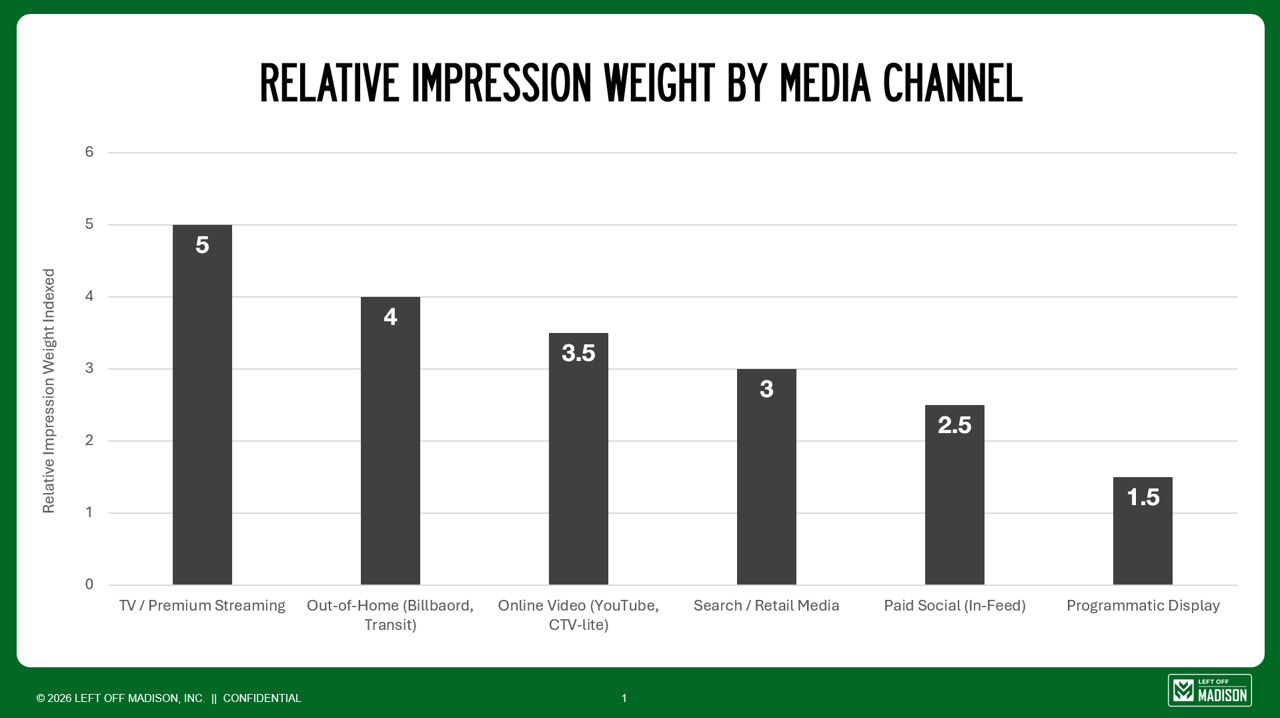
TV / Premium Streaming (Index ~5)
Highest attention, longest dwell time, strongest emotional and memory impact.
Out-of-Home (Index ~4)
Massive format + unavoidable presence = high recall and legitimacy, even without clicks.
Online Video / CTV-lite (Index ~3.5)
Strong sight, sound, motion—but often fragmented attention.
Search / Retail Media (Index ~3)
Lower emotional impact, but very high intent and action-weight.
Paid Social (Index ~2.5)
Fast decay, high frequency needs, highly dependent on creative quality.
Programmatic Display (Index ~1.5)
Useful for reminders and scale, but weakest standalone influence.
Yet many media plans treat all impressions as interchangeable. They count volume instead of weighing influence.
Effective frequency isn’t about stacking more impressions. It’s about stacking the right ones.
Attention Is the Multiplier
The third— and most critical— variable is attention. An impression only matters if it’s noticed. Consumer attention varies dramatically based on:
Media platform
Placement
Context
Environment
Mood
A consumer leaning into a show they love is more receptive than someone doom-scrolling a feed. A large-format out-of-home placement commands attention differently than a small mobile banner. A contextual digital ad aligned with intent carries more weight than one dropped into a cluttered environment.
Attention is what turns exposure into memory—and memory into action.
As obvious to us as this to us, it is not for everyone. We confront this most with product managers who are less savvy or experienced in the fine art of marketing.
How 3-to-8 Works in the Real World
The most effective campaigns don’t chase frequency in one channel. They orchestrate frequency across channels. A typical path might look like this:
A consumer first notices a brand on TV or streaming
Sees it again on a billboard during a commute
Encounters it in a social feed
Is reminded through search or retail media
Sees it one more time before purchase
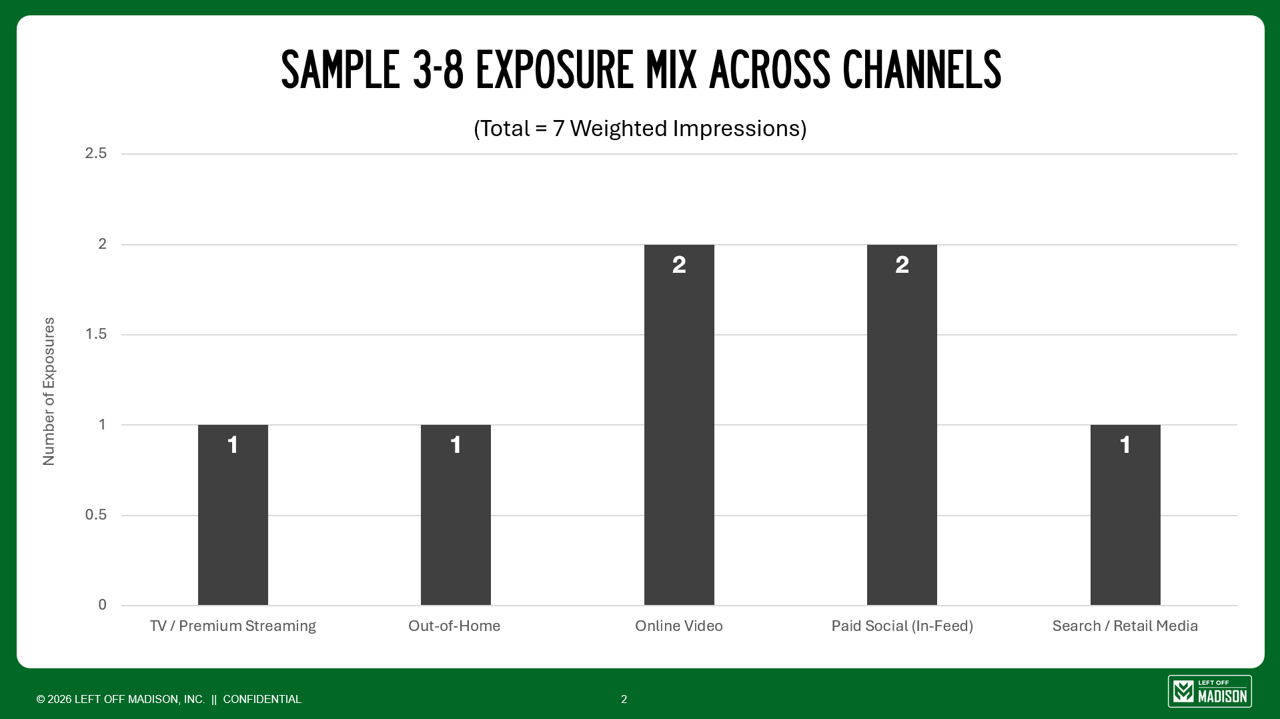
That’s not repetition. That’s reinforcement. Each touchpoint adds familiarity, trust, and credibility. By the time the consumer is asked to act, the brand no longer feels new. It feels known. This chart below shows a realistic 7-touch exposure path that actually motivates action.
Why this mix works:
TV / Premium Streaming (1 exposure)
High-attention introduction. Establishes legitimacy fast.Out-of-Home (1 exposure)
Public, unavoidable reinforcement. Builds mental availability.Online Video (2 exposures)
Adds sight, sound, motion—drives message retention.Paid Social (2 exposures)
Keeps the brand present in daily behavior; reinforces familiarity.Search / Retail Media (1 exposure)
Captures intent and closes the loop.
This is not 7 equal impressions. It’s 7 weighted moments, each doing a different job.
That’s the heart of 3-to-8 To Motivate.
Why This Matters More Than Ever
Media fragmentation didn’t eliminate frequency. It made it harder to manage. Brands that chase cheap impressions in a single channel often overestimate impact and underestimate fatigue. Brands that design cross-channel frequency systems create momentum that feels natural, not forced.
In a world where attention is scarce and skepticism is high, consumers don’t respond to being shouted at. They respond to brands that show up consistently, in the right places, at the right moments.
That’s what 3-to-8 To Motivate is really about—and why frequency, not reach alone, is what drives action today.